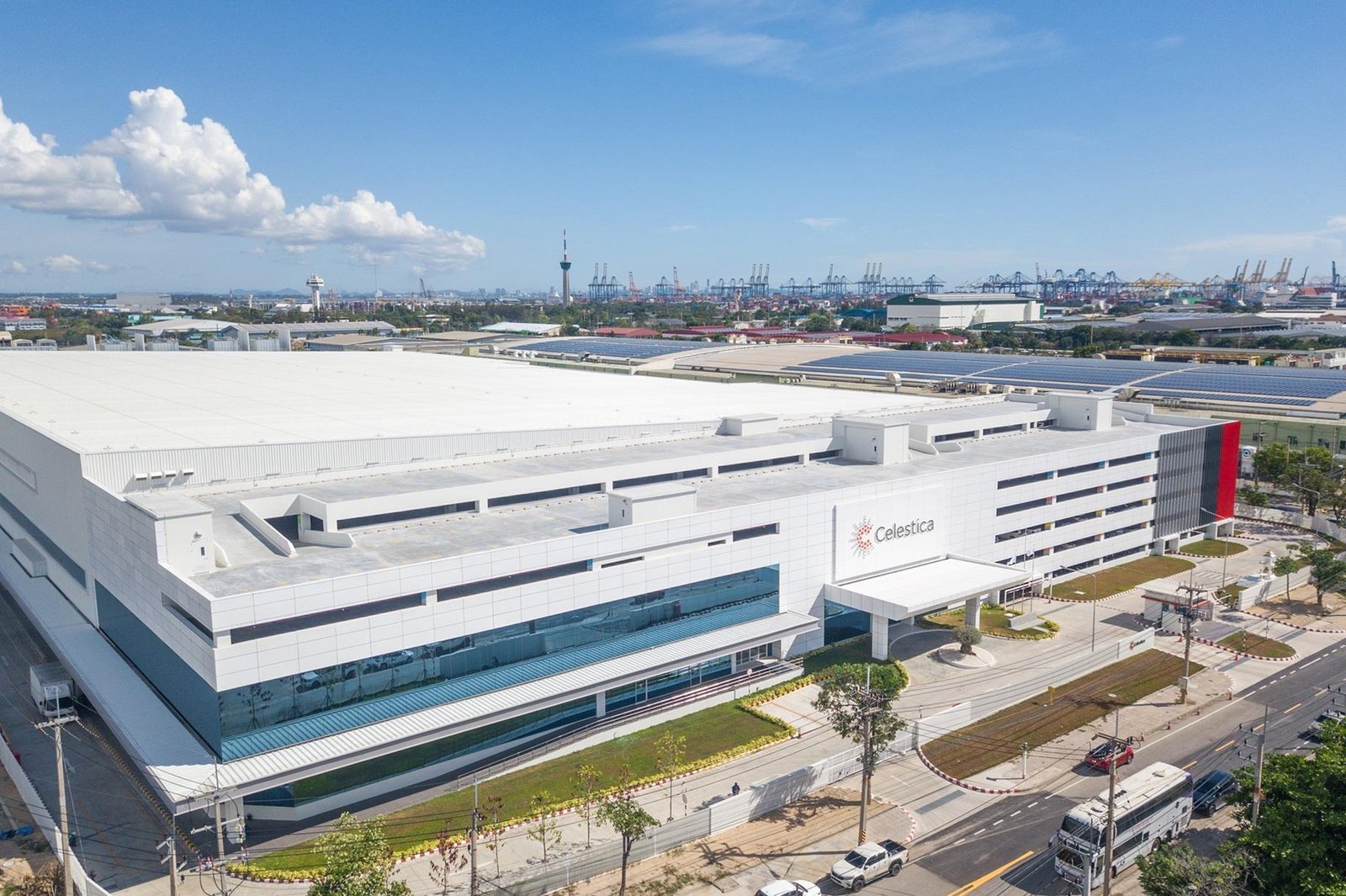
Celestica told investors its quarter would land between $5.25 billion and $5.55 billion. It reported $5.83 billion instead, 83 per cent above the year-earlier figure, and used the surprise to lift the numbers it had given for the year after next as well.
The Toronto company manufactures switches, servers and complete racks under contract for the firms building AI clusters. Adjusted earnings came in at $3.30 a share against $1.58 a year earlier, and adjusted operating margin reached 8.5 per cent, the best in its history. On standard accounting the operating margin slipped to 7.9 per cent from 10.2 per cent, a gap that reflects stock compensation and the amortisation of acquired assets rather than anything happening on the factory floor.
Contract manufacturing is a business of thin spreads and heavy working capital. A customer specifies the design, the manufacturer buys the parts, holds the inventory and ships, and earns a few cents on each dollar of revenue. Margins move when capacity is scarce, because the buyer’s alternative is to wait, and they collapse when it is not.
That is what the quarter describes. The customers are the hyperscalers and the network-equipment vendors selling into them, and demand for high-speed switching and rack-scale systems has run ahead of the lines available to build them. Celestica raised its 2026 revenue guidance to $21 billion from $20.5 billion, implying growth of 69 per cent, and lifted adjusted earnings guidance to $11.55 a share.
The one figure that moved the wrong way was cash. Guidance for full-year free cash flow fell to $460 million from $600 million, which is what happens when revenue grows faster than collections: inventory is bought months before it is billed, and receivables stretch as shipments concentrate at the end of a quarter.
For 2027 the company gave a first outlook rather than a range, which is unusual this early. Revenue of $40 billion would be 90 per cent higher again, adjusted earnings of $21.50 a share would nearly double, and capital spending would reach $1.5 billion to $2 billion. That last number is the tell. A manufacturer spending at that rate is buying its own lines instead of renting capacity from someone else, which turns a variable cost into a fixed one.
Fixed costs are what turn a good year into a bad one when demand stalls. Celestica was assembled out of IBM’s contract manufacturing business, spent the early 2000s digesting acquisitions, and took most of a decade to rebuild margins after the telecom bust. Management’s description of the current market as a supercycle in AI infrastructure is a claim about duration, and duration is the one variable the company cannot control.
Customer concentration is the other exposed flank. A handful of buyers account for most of the revenue, and those buyers design their own hardware, qualify second sources as a matter of policy, and negotiate contracts every year. The pricing power a supplier holds in a shortage is rented, not owned.
The comparison set is unforgiving. The Taiwanese and American contractors that build the same class of product run on similar spreads, and they are adding capacity at the same time. A fivefold increase in rack assembly across the industry would meet the current order book and then sit idle, which is how the sector has historically ended its booms.
Analysts who follow the company said the guidance raise was less interesting than the capital plan, because it commits Celestica to capacity that has to be filled in 2028 and 2029. If the cluster build-out slows, the depreciation arrives anyway, and a manufacturer cannot write down a lease it has already signed.
There is a counter-argument, and it rests on the physical world rather than the financial one. Power, not circuit boards, is the binding constraint on new capacity in most American markets, and interconnection queues in the large data-centre counties now run to five years or more. A manufacturer with qualified lines and leased buildings holds an option that a competitor cannot buy at any price, and that option is worth a lower margin and a thinner cash flow statement.
What the guidance also implies is hiring and floor space. A business adding ninety per cent to revenue in a year needs second shifts, additional test capacity and buildings near the customers it serves, and those commitments are made before the orders are confirmed. Celestica’s own forecast assumes the orders arrive.
One detail in the outlook deserves attention. The forecast implies revenue growth that outpaces the volume of racks the industry is expected to ship, which means the company is assuming more content per rack: faster switching, denser power distribution, more of the assembly work pulled in-house. That mix shift is how a contractor lifts margin without raising its price.
The shares have tracked the mood of the sector rather than the company’s execution, and the 2027 target puts a number on how much of the build-out Celestica expects to capture. Whether the market accepts that number is a question about AI capital spending rather than about manufacturing, and the answer will be delivered by the customers, in their own guidance, over the next two quarters.