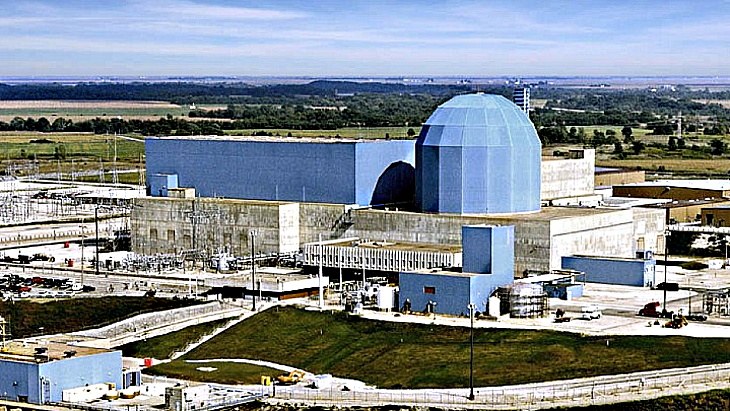
Chris Wright picked the site as carefully as the number. Standing at an Illinois nuclear plant that sells its output to Google, the energy secretary said Tuesday that the federal government would stand behind as much as $5 billion of loans to Constellation Energy for work at eight reactors in three states.
The commitment comes from the Energy Department’s Office of Energy Dominance Financing, and it is conditional. It would fund upgrades and modernization at plants in Illinois, Maryland and Pennsylvania designed to add about 1.1 gigawatts of capacity, roughly the output of a new large reactor built without a new reactor.
An uprate is unglamorous engineering. Operators replace turbine rotors, rewind generators, add cooling capacity and push more steam through equipment that was originally built with margin. The gains arrive a few dozen megawatts at a time, and they are measured against a plant that already runs most hours of the year.
Constellation has spent two years arguing that this is the fastest firm megawatt available to the data center industry. The company says 20-year supply agreements with Google and Amazon have supported more than $7 billion of investment and about 1,080 megawatts of new nuclear capacity. A separate agreement with Meta underpins a 30-megawatt expansion at the Clinton Clean Energy Center in Illinois.
Executives describe uprates as the quickest increment available when an operator can neither add a generating unit nor build a transmission corridor. Both of those take longer than the customers want to wait.
The federal money addresses the cost of capital, not the demand. Constellation’s case to a lender rests on contracts signed with three of the largest buyers of power in the country, and those contracts are what make the asset financeable at a low rate. A conditional commitment lowers the hurdle. It does not clear it.
Conditional commitments are also not checks. The department generally requires borrowers to satisfy engineering, permitting and offtake conditions before funds are drawn, and a commitment can lapse when a project changes shape. The eight reactors will each need their own regulatory review, because an uprate is licensed plant by plant rather than as a single program.
The work itself is constrained by people and parts. Uprate projects depend on a small number of heavy-equipment shops able to handle large turbine and generator components, and on welders and technicians qualified for nuclear service. Both are in demand across an industry that is simultaneously extending the lives of existing plants.
Then there is the shape of the revenue. Twenty-year agreements with Google, Amazon and Meta convert what was once merchant risk into something closer to a utility contract, which is precisely why lenders will accept a lower return. The trade is duration for certainty: the plant gives up the chance to sell into a high-priced spot market in exchange for a customer that pays whether or not the spot market is high.
For the buyers, the appeal is different. Data center operators have pledged to match their electricity use with carbon-free generation around the clock, and a nuclear plant is one of the few sources that produces at a steady rate regardless of weather. Wind and solar need storage or a gas plant behind them to make the same promise, and neither is cheap at the scale these campuses require.
Wright’s choice of backdrop made the political argument explicit. The financing office he runs was renamed to signal that the government intends to use credit support as an instrument of supply policy, and the first large nuclear announcement under that banner took place at a plant whose customer is a software company. Federal money on the supply side, private money on the demand side, with the plant in the middle.
The numbers are smaller than the headline. A 1.1 gigawatt gain across eight reactors is a fraction of what the largest cloud companies have said they need, and much of it will arrive one license amendment at a time. Constellation calls the approach the fastest available route to new supply, and on the current timeline that claim is hard to dispute: the alternatives are a new reactor, which takes a decade or more, or a new transmission line, which takes nearly as long and requires the consent of every jurisdiction it crosses.
What the loan does not do is create the customer. The 1,080 megawatts already added under the Google and Amazon agreements were justified by contracts, not by federal credit, and the Meta arrangement at Clinton followed the same pattern. The government is arriving after the demand has been contracted, which is the cheapest moment to arrive and the least risky for the taxpayer.
The test will be whether the remaining capacity at these sites can be sold on similar terms. If the three hyperscalers keep signing 20-year deals, the uprate program becomes routine maintenance with a financing wrapper. If they slow down, the plants will still run, the loans will still be drawn, and the power will have to find another buyer.
That is the ordinary risk of building supply ahead of demand, and it is a risk the federal government has now taken a share of. The 1.1 gigawatts will show up in the interconnection records long before they show up in quarterly results. How quickly depends on turbine deliveries, on the review queue, and on whether the plants have as much margin left in their equipment as their owners believe.