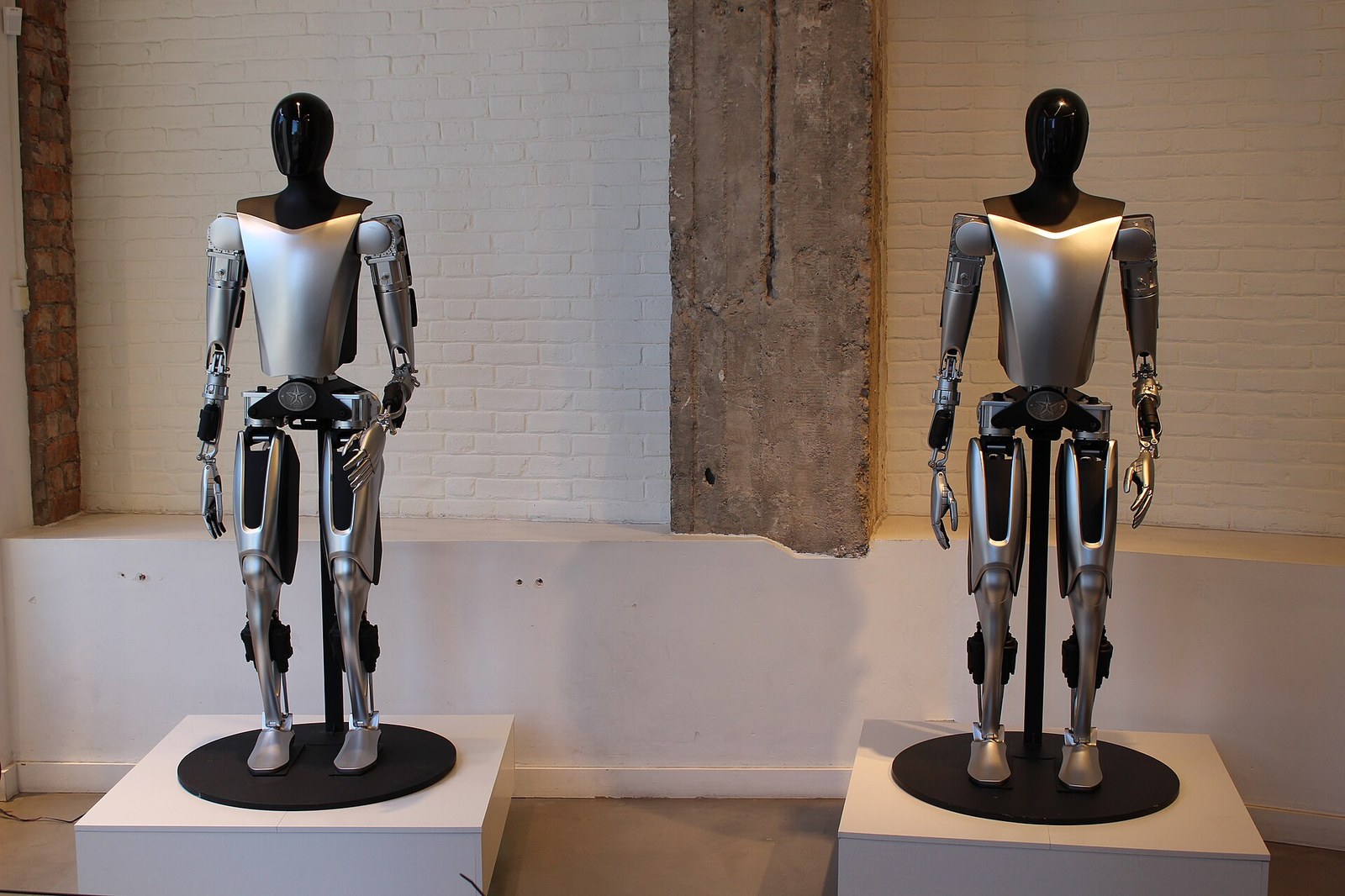
Tesla has begun what it calls early production of its Optimus humanoid robot at its Fremont, Calif., plant, moving its least proven product into manufacturing before it has a customer base able to absorb the output.
On the third-quarter earnings call, Chief Executive Elon Musk said deliveries to customers could start next year. Tesla has installed most of a line at Fremont rated for one million robots a year, though the company says reaching that rate could take more than a year. Early production, in Tesla’s usage, means low volumes built on equipment that is still being qualified.
The distance between a line designed for a million units and a customer list with no names on it is the central fact of the program. Tesla’s answer is to become its own first customer. It plans an “Optimus Academy” holding between 10,000 and 20,000 robots, machines that perform tasks in order to record the data used to train the model. That is a large amount of floor space and capital committed to units that will never be sold.
The company also intends to put its own silicon inside the robot, integrating the AI5 chip in April, with chips supplied from its Terafab plant in Texas. Vertical integration has been Tesla’s argument in cars, where it builds motors, batteries, software and charging equipment, and the same logic is being applied here at a point when the product has no established market and no benchmark for what it should cost.
Humanoid robots have drawn capital for a decade on the promise of factory and warehouse work. The constraint that has held them back has not been manufacturing capacity. It has been dexterity, reliability and the data required to teach a machine to handle objects it has never seen. A line rated at a million units does not address any of those problems. A training fleet of 20,000 machines might, eventually, and at a cost that will not appear as research spending once the robots are built on a production line.
The more measurable half of the same bet is already on the road. Registration data from the Texas Department of Motor Vehicles shows Tesla’s autonomous fleet passed 1,000 vehicles on Oct. 27 and reached 1,080 the following day. Cybercab, the two-seat vehicle built for driverless service, accounted for 573 of them, passing the Model Y at 507 for the first time. The cars are registered across six cities.
Paid Cybercab service, however, is offered in Austin only. Elsewhere the vehicles are registered and operating without collecting fares from passengers in driverless cars. Tesla has not disclosed revenue per vehicle, utilization or the cost of running the fleet, which leaves the registration count as the only hard measure of the business outside its own statements.
That count is small next to the fleets of established ride-hailing platforms, and the vehicles are expensive assets to hold while utilization is being built. The question investors have asked for years is when the software becomes good enough that a car without a driver earns more per mile than one with a driver. The register does not answer it.
Nor is the regulatory path settled. The National Highway Traffic Safety Administration has been investigating since September whether Cybercab complies with federal motor vehicle safety standards, a question that follows directly from a vehicle designed for a service rather than a driver. A finding against the design would affect deployments beyond Texas.
Tesla has a history of setting dates it does not meet, particularly on autonomy, and executives have been careful to describe the next twelve months as preparation rather than a launch. Musk’s phrasing on the call, that deliveries could begin next year, carries less weight than the installed capacity figure the company has chosen to publicize.
The two programs share a balance sheet and a narrative. Both consume cash years before they produce revenue at scale, both depend on in-house chips, and both are being financed by a vehicle business whose growth has slowed. Capital allocated to a million-unit robot line is capital not available for the next factory, and the decision to build capacity first is a bet that demand will follow rather than the other way around.
For investors the distinction is straightforward. A vehicle count filed with a state agency can be checked every month, and it is moving: 1,000, then 1,080, with the purpose-built model now the largest single group. A production line rated at a million units and a delivery date of “next year” cannot be checked at all until robots are sold to someone other than Tesla.
The next twelve months will show which of the two numbers matters. If customer deliveries begin and the academy fills, the Fremont line stops being a demonstration and becomes a business. If they slip again, Tesla will have built the capacity to make a product it still cannot sell.