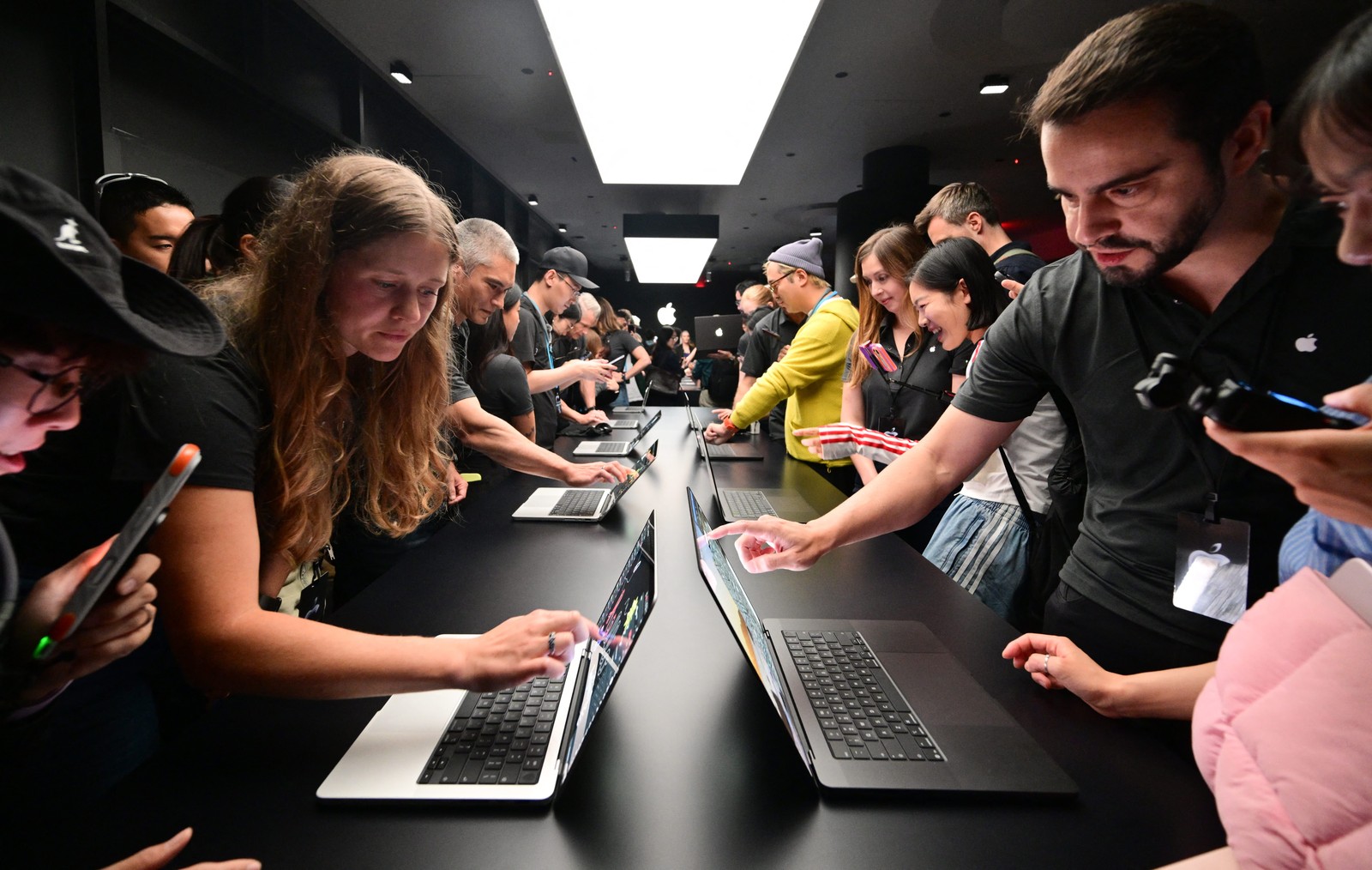
The feature Apple spent a decade telling customers a laptop did not need now costs $400. The company announced a touchscreen MacBook Pro on Wednesday, with the 14-inch model starting at $2,899 and the 16-inch at $3,399.
Fully configured, a 16-inch machine reaches $14,549. The new models carry a premium of about $400 over the equivalent non-touch versions, which Apple also sells.
The display is the reason the price is defensible. Apple calls it PROLED XDR, a tandem OLED panel with a peak brightness of 2,000 nits and a contrast ratio of 10 million to one. It runs on the M5 Pro and M5 Max chips, with up to 128 gigabytes of unified memory and 16 terabytes of storage. The 14-inch weighs 1.38 kilograms and the 16-inch 1.82 kilograms, both lighter than the models they replace, which is not what usually happens when a display gains a digitizer.
The engineering problem was never the panel. It was the hinge. A laptop screen that responds to a finger needs to stay still while the finger presses, and most touchscreen laptops wobble at the moment of contact. Apple says it redesigned the hinge to absorb that force, and it moved the camera housing from a notch to a pill-shaped cutout that resembles the Dynamic Island on the iPhone, giving the menu bar more room around it.
The ports are the ones professionals have been asking for: three Thunderbolt 5, HDMI, an SDXC card slot, MagSafe and a headphone jack. There are six speakers.
For Apple, this is a reversal with a long paper trail. The company shipped the Touch Bar in 2016, a thin OLED strip above the keyboard that was meant to make the function row contextual. Developers ignored it, users missed physical keys, and Apple removed it from the lineup entirely by 2023. Before that, Steve Jobs argued in 2010 that touch surfaces do not want to be vertical, a comment that became the company’s settled position for fifteen years.
The position held for reasons that were partly technical and partly commercial. Reaching over a keyboard to touch a screen is awkward for long sessions, fingers cover what they are pointing at, and the iPad existed to serve the customers who wanted direct manipulation. Adding touch to the Mac risked cannibalizing a tablet business that Apple has spent a decade trying to position as a computer.
That logic has eroded from both ends. The iPad Pro now runs on the same silicon family as the MacBook Pro and costs a similar amount when configured with a keyboard. Microsoft’s Surface has offered touch on a laptop since 2012, and touch is standard on midrange Windows machines. Apple’s own software has been moving toward larger touch targets for years, even as macOS kept a pointer-first interface.
What Apple has not said is how the software will use the input. A touch layer without interface changes is a display that can be poked, which is worth something to a photographer reviewing a shot or an illustrator blocking in a sketch, and worth less to a developer in a terminal. The company demonstrated the hardware on Wednesday and left the software argument for the reviews.
The pricing tells you where Apple thinks the demand is. A $400 premium on a machine that starts near $2,500 is a tax on a feature, and Apple has historically charged for features it believes are optional rather than essential. The base models without touch stay in the lineup at lower prices, which keeps the entry point intact and makes the touchscreen an upsell rather than a replacement.
For the creative customers who buy the 16-inch, the calculation is less about $400 and more about the upgrade cycle. These machines are replaced every three to four years by people who bill by the project, and a display that accepts a finger changes how a storyboard gets reviewed in a room. Whether it changes how the work gets made is a different question, and one that will be answered by whether the apps people use every day add touch support or ignore the panel the way they ignored the Touch Bar.
The competitive picture is unflattering in one respect. Apple is arriving at touch on a laptop more than a decade after the rest of the industry, and it is charging more for it than most rivals charge for an entire machine. The counter is that no Windows laptop ships a tandem OLED panel at 2,000 nits with this silicon, so the comparison is not like for like.
What comes next is a question about the Mac line itself. A touchscreen on the most expensive laptop is a test, and the result will decide whether the feature moves down to the MacBook Air, where the volume is. Apple has run this play before with displays, ports and chips. If touch stays at the top of the range for another three years, the experiment will have failed quietly. If it reaches the Air, the company will have conceded an argument it spent fifteen years winning.