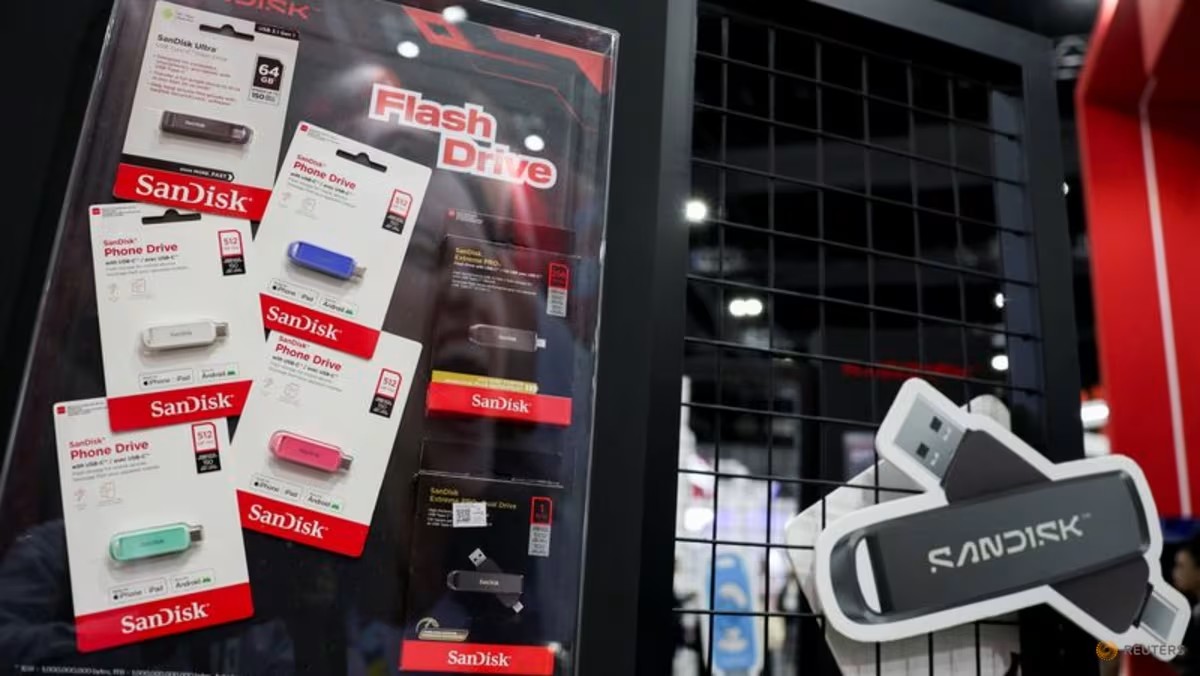
There was a stretch, not long ago, when makers of NAND flash sold chips for less than they cost to produce and wrote down the inventory while they did it. On Thursday SanDisk reported an adjusted gross margin of 85.1%.
The company, which makes flash memory and was separated from Western Digital, said fiscal first-quarter revenue reached $11.03 billion, up 378% from a year earlier and above the $10.69 billion analysts expected. Adjusted earnings per share were $49.51 against an estimate of $46.36. On a reported basis, earnings per share came to $52.60.
Those margins are not a normal feature of the memory business. They are what a market looks like when demand exceeds supply by a wide margin and the supplier can price accordingly.
The guidance suggested the condition persists. SanDisk told investors to expect fiscal second-quarter revenue of $12.2 billion to $12.6 billion, against a consensus of $12.1 billion, with adjusted gross margin of 84.5% to 85.5% and adjusted earnings per share of $55 to $57, compared with an expected $52.72. The margin range implies almost no erosion from the current quarter, which is the detail that matters more than the revenue figure. In past cycles, peak margins lasted a quarter or two before capacity arrived to compete them away.
Management’s explanation is that the capacity has already been spoken for. About half of the company’s output for fiscal 2027 and roughly two-thirds for fiscal 2028 are committed under long-term contracts written into what SanDisk calls its new business model, or NBM. After customers added to their orders, the company said its supply is booked out to 2030.
That is a different kind of memory company from the one investors have known. In past cycles, NAND makers sold into spot and contract markets at prices set quarterly, which meant their revenue tracked the cycle rather than their own order book. Long-term agreements with volume and price terms convert a commodity business into something closer to a subscription, at least for the portion of output covered.
The data center segment is where the shift is visible. Revenue there was $4.8 billion, up 61% from the previous quarter. That growth rate, applied to a segment of that size, is the clearest evidence that the buyers are not consumers replacing phones but operators building clusters for AI inference.
Inference is the part of the AI buildout that consumes flash rather than high-bandwidth memory. Training a model is a compute problem with a large memory requirement attached. Serving a trained model to millions of users is a storage problem, because the system has to hold the key-value cache, the intermediate state that lets a model respond without recomputing everything it has already read. That cache has grown as context windows have lengthened, and it has to live somewhere fast and cheap.
SanDisk expects key-value cache to account for about a third of the AI data center flash market by the end of the decade. If that is right, the addressable market for its highest-margin product expands for several years regardless of how many new model training runs are funded.
The company also said its first high-bandwidth flash chip, known as HBF, has completed tape-out, with samples going to customers next year. HBF is an attempt to place flash on the memory bus in the way high-bandwidth memory sits beside a processor, trading some speed for far greater capacity per dollar. If it works at scale, it changes the economics of inference servers, which today spend a large share of their bill of materials on memory that is fast and small.
None of this makes SanDisk immune to the cycle it has just escaped. Memory has punished every company that assumed the good times would persist, and the mechanism is always the same: high margins attract capacity, capacity arrives, prices fall. What is different this time is that a large share of the new capacity is being built against signed contracts rather than in anticipation of demand.
The risk sits in those contracts. Long-term agreements protect a supplier when prices fall, and they cap it when prices rise. If NAND prices keep climbing through 2028, SanDisk will be delivering a substantial portion of its output at terms negotiated in 2026. Customers, for their part, are accepting those terms because the alternative is having no supply at all, which for a company building data centers is worse than paying a premium.
The second risk is technical. HBF is unproven at volume, and the customers sampling it next year will decide whether it becomes a standard or a niche. A failure there would leave SanDisk selling conventional flash into a market where competitors are also adding capacity.
The stock has been one of the more volatile large-cap names in the sector, and the results landed in a week when investors were already marking down anything tied to AI capital spending. Alphabet fell more than 11% in a session, Intel guided below expectations, and Amazon’s free cash flow turned sharply negative. A memory supplier reporting 85% gross margins is, in that context, an awkward data point: it shows where the money in the AI buildout is actually landing.
For now, the money is landing on the suppliers with scarce capacity and signed orders. SanDisk has both, and it has told investors how long they will last. The company’s task over the next two years is to convert a cycle into a franchise, by making the contracts stick through a downturn and by proving that flash belongs on the memory bus rather than beside it.