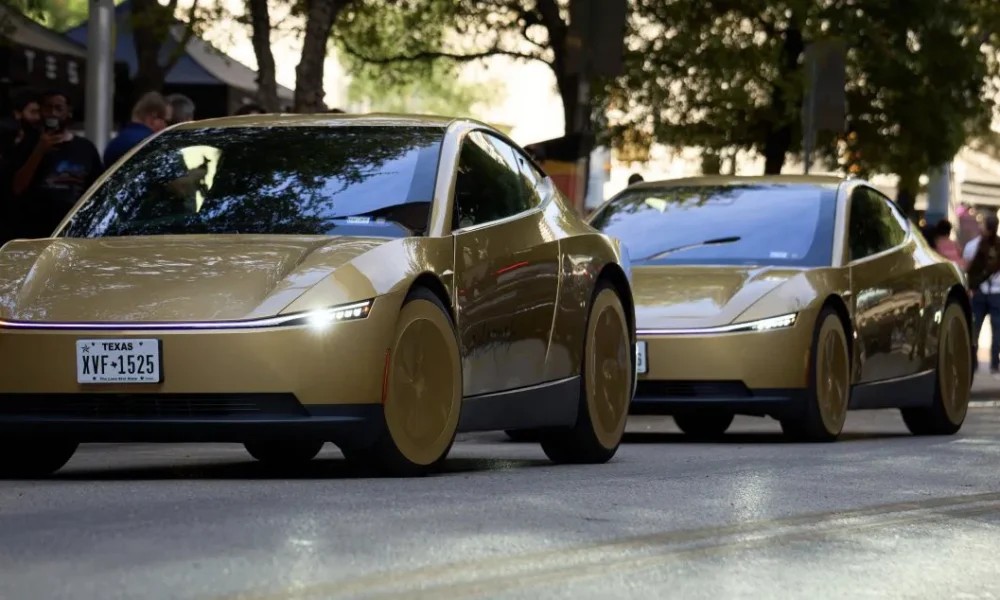
At 2 a.m. on Saturday, a Tesla with no one at the wheel will still be available for hire in Austin. The company said its robotaxi service will run from 6 a.m. until 2 a.m. starting October 30, pushing its closing time two hours past midnight, the second extension in ten days.
The first extension came on October 21, when Tesla moved the Austin service’s last pickup to midnight. Ten days later it added two more hours. Each change is small in itself and consistent in direction: the fleet is being asked to work a longer shift, which is what an operator does when utilization is the constraint rather than demand.
Alongside the hours, Tesla added features that read like a checklist assembled from complaints. Passengers will see a rear-camera feed inside the app, can share their trip with someone outside the vehicle, and get a redesigned live-activity interface that shows the car’s position and status on the lock screen. Model Y owners are getting Grok, the company’s chatbot, integrated into the vehicle.
None of that is autonomous-driving technology. It is the unglamorous product work that turns a demonstration into a service: the reassurance features a passenger wants at 1 a.m., the status display that reduces the number of times someone opens the app, the in-car assistant that gives the cabin something to do. Tesla has been criticized, fairly, for treating the driverless problem as one problem. The last two weeks suggest it has noticed there are others.
The service itself remains confined to Texas. It began in Austin in June 2025 with a small fleet of Model Ys and a safety monitor in the passenger seat, and it has expanded within the state while staying out of the markets where Tesla’s customers are densest. California, where the company is headquartered and where its vehicles are most common, has not been opened to driverless operation, and the state’s regulator has been explicit that a permit for testing is not a permit for charging passengers.
The reason is regulatory rather than technical. Texas allows autonomous vehicles to operate under a light state framework, with registration and insurance requirements but no cap on the number of vehicles and no requirement for a state-issued deployment permit. California requires permits for testing with a safety driver, for testing without one, and for commercial deployment, each with its own reporting obligations. The gap between those two regimes explains the map of Tesla’s service better than any engineering achievement.
Which makes the company’s other move this week the more consequential one. Tesla has asked the Australian government to allow a driverless pilot in 2027, and is seeking federal regulatory support rather than approaching state authorities one at a time. Australia’s states have taken different positions on autonomous vehicle testing, and a company that wants to operate across the country needs a national framework rather than eight separate approvals.
Australia is an odd first choice for a company that has spent a decade promising a coast-to-coast American robotaxi network, and the oddness is the point. The country has a small, dense set of cities, right-hand-drive vehicles, a national road-safety regulator willing to engage, and no incumbent robotaxi operator with a large fleet. It is a market where a modest deployment can look like a national one.
The competitive picture has changed since the Austin launch. Waymo operates paid driverless service in several U.S. cities and announced this week that it will put a Toyota-built fleet on Japanese roads from 2027 with the bZ4X, manufactured by its partner and driven by its own system. That announcement is a template: a carmaker supplies the vehicle, the software company supplies the driver, and the two share the regulatory burden in each market.
Tesla is trying to do both jobs at once, which is cheaper and slower. It owns the factory and the fleet, so it does not have to negotiate a revenue split or wait for a partner’s product cycle. It also has to convince every regulator on its own, with a system whose performance data it controls and has not published in the detail its rivals have.
The later hours are a bet on data as much as on revenue. Every additional hour of operation generates miles that a driverless system has not seen at that time of night, in those lighting conditions, with that mix of pedestrians and delivery traffic. Tesla’s approach to autonomy depends on accumulated fleet data more than on the curated mapping that Waymo uses, and the marginal hour between midnight and 2 a.m. is unusually valuable because it is where the sensor suite’s failure modes concentrate.
What Tesla has not disclosed is how many vehicles are actually in service in Austin, and what share of requests they complete. The company reports deliveries, energy storage and, now, chatbot integrations. It has not reported rides, wait times or intervention rates, the three figures that would let an outside observer judge whether the service is a business or a demonstration.
The Australian request suggests the company expects to be judged on the second question soon. A pilot in 2027, with federal backing, would give Tesla a market where it can publish results without the comparison to Waymo’s denser urban networks that any U.S. expansion invites. It would also test whether the system generalizes to right-hand-drive roads, different signage and a regulatory culture that asks for evidence before permission rather than after.
Until then, the visible progress is a schedule. Two hours later at the end of the day, a camera view in the app, a chatbot in the dashboard. For a company that has spent a decade describing autonomy as a software problem that would be solved in a single step, the incrementalism is the news.