Intel will take production lines at its Oregon factories off client chips and put them on server processors, the company confirmed on Oct. 31. The change follows a quarter in which data-center and AI revenue reached $7.3 billion, up 17% from the prior three months and nearly 80% from a year earlier.
PC shipments fell more than 20% over the same period.
Intel has one constrained supply of wafers and two businesses asking for it. It has decided which customer waits.
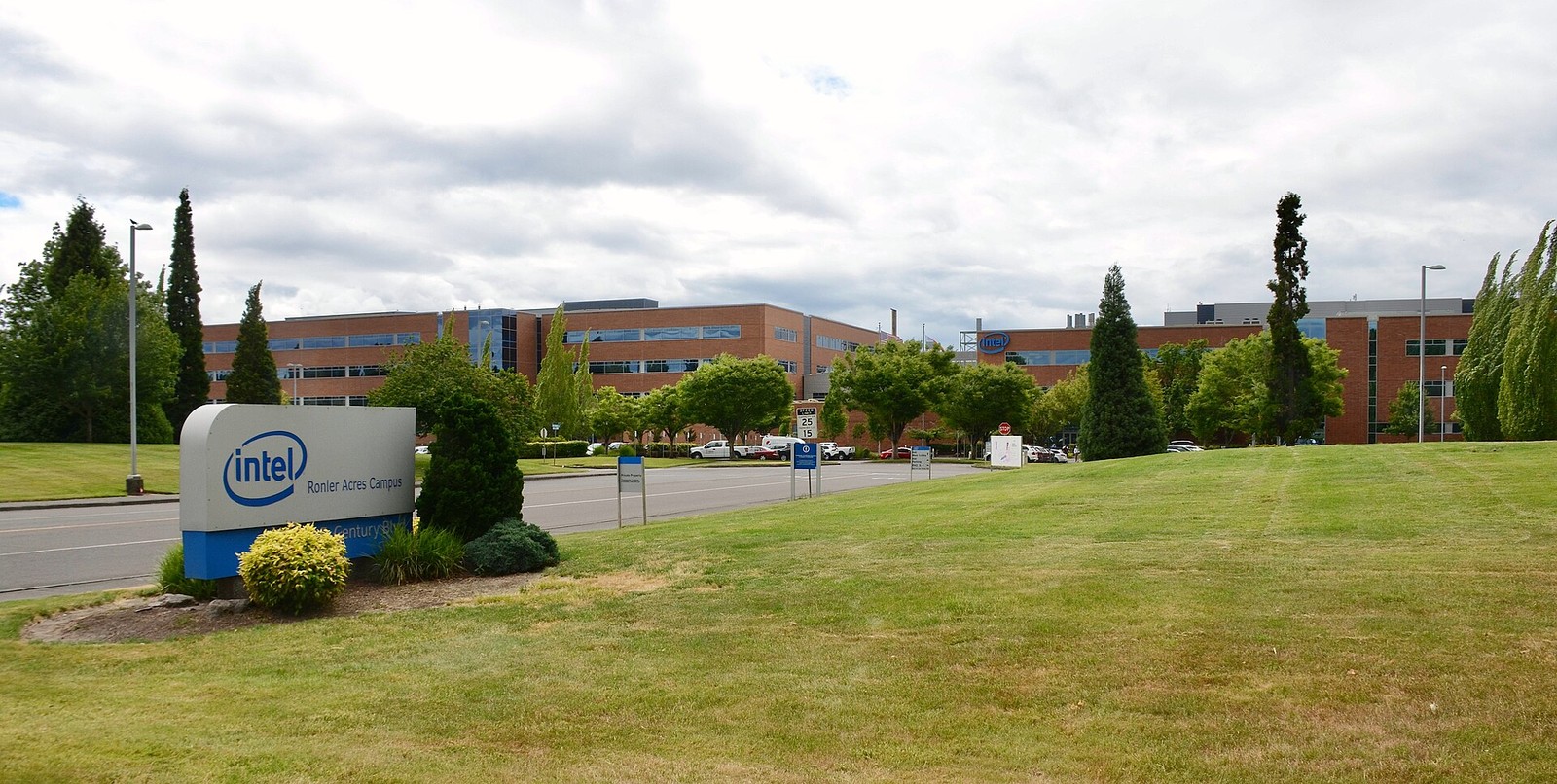
The work is a scheduling change rather than a construction project. Intel’s Oregon operations, built around the Ronler Acres campus west of Portland, hold the company’s largest concentration of manufacturing and process development. Capacity there was committed to client parts for the quarters ahead. Those commitments now move to Xeon.
Intel said the shift reflects demand for AI computing that has run ahead of what the company planned for. The same site is ramping Intel’s most advanced process, 18A, and that ramp competes for the same tools, the same cleanroom space and the same engineers.
Oregon carries more weight than any other Intel site in this decision. The state hosts the company’s process development teams, the engineers who translate a design rule into something a fab can run, and it has been the first place Intel has introduced each new node. When those teams are asked to support a product ramp on short notice, the ripple reaches outside the wafer line.
The arithmetic favors the move in the near term. A server processor sells for several times the price of a notebook chip and occupies a larger die, so a wafer pointed at the data center returns more revenue per square millimeter.
Intel’s gross margin has been compressed by the cost of standing up new capacity, and a richer mix helps at the margin line.
The client side is not a rounding error. Client computing has historically supplied the largest share of Intel’s revenue, and a decline above 20% is a hole that server growth only partly fills. Notebook makers entered the year planning to build more machines than they will now assemble.
Part of that weakness is not Intel’s to fix. Memory prices rose through the year as suppliers moved DRAM capacity toward the high-bandwidth memory that ships with AI accelerators, and PC makers cut build plans rather than absorb the increase.
Intel’s own commentary in October put the shortfall on memory availability as much as on demand for computers.
The server market has also changed shape. Cloud providers now design their own processors, and Arm-based parts have taken a slice of the general-purpose work that Xeon once handled alone. Intel’s response has been to argue that the installed base of software written for its instruction set is the real moat, and that argument holds best when the chips are available.
A customer that cannot get delivery dates starts auditing that moat.
A delayed allocation is an invitation. Advanced Micro Devices has taken server share from Intel for several years, and PC makers such as Dell, HP and Lenovo qualify alternate platforms on cycles measured in quarters.
A customer that cannot get parts in the first half of 2027 has a reason to test a second source and to keep it.
Intel has also been shrinking. The company has cut thousands of jobs across its manufacturing and engineering organizations over the past two years, and Oregon absorbed a large share of those reductions. Fewer people running the same tools makes each reallocation of capacity more expensive to execute, and makes the qualification work slower.
Converting a line is not a switch. Process qualification, assembly and test have to be re-run for the new part, and output is booked several quarters out. The revenue Intel is protecting arrives through next year, not in the December quarter, which means the current quarter absorbs the disruption without the offset.
There is also the demand question. The buyers of AI servers are mostly cloud providers and model developers who are financing an enormous build-out, part of it with borrowed money. If their orders are pulling capacity forward rather than reflecting steady utilization, Intel will have moved scarce wafers to the more cyclical end of its market at the moment that end looked safest.
The foundry ambition cuts the other way. Intel wants outside customers to fill these same Oregon lines under its contract manufacturing business, and outside customers, unlike Intel’s own product groups, can leave. A company that cannot hold a delivery date for PC makers will be asked about the record when it pitches a fab.
Intel has spent three years telling investors that its manufacturing network would become an advantage again. The October decision is a smaller and more concrete version of that claim: it gives away one set of customers in order to serve another.
Whether that reads as discipline or as a bet on a single strong quarter will be clear in the first half of 2027, when the converted lines report and the PC customers who were pushed back decide whether to come back.