The knife, Yuval Noah Harari said, is the wrong comparison.
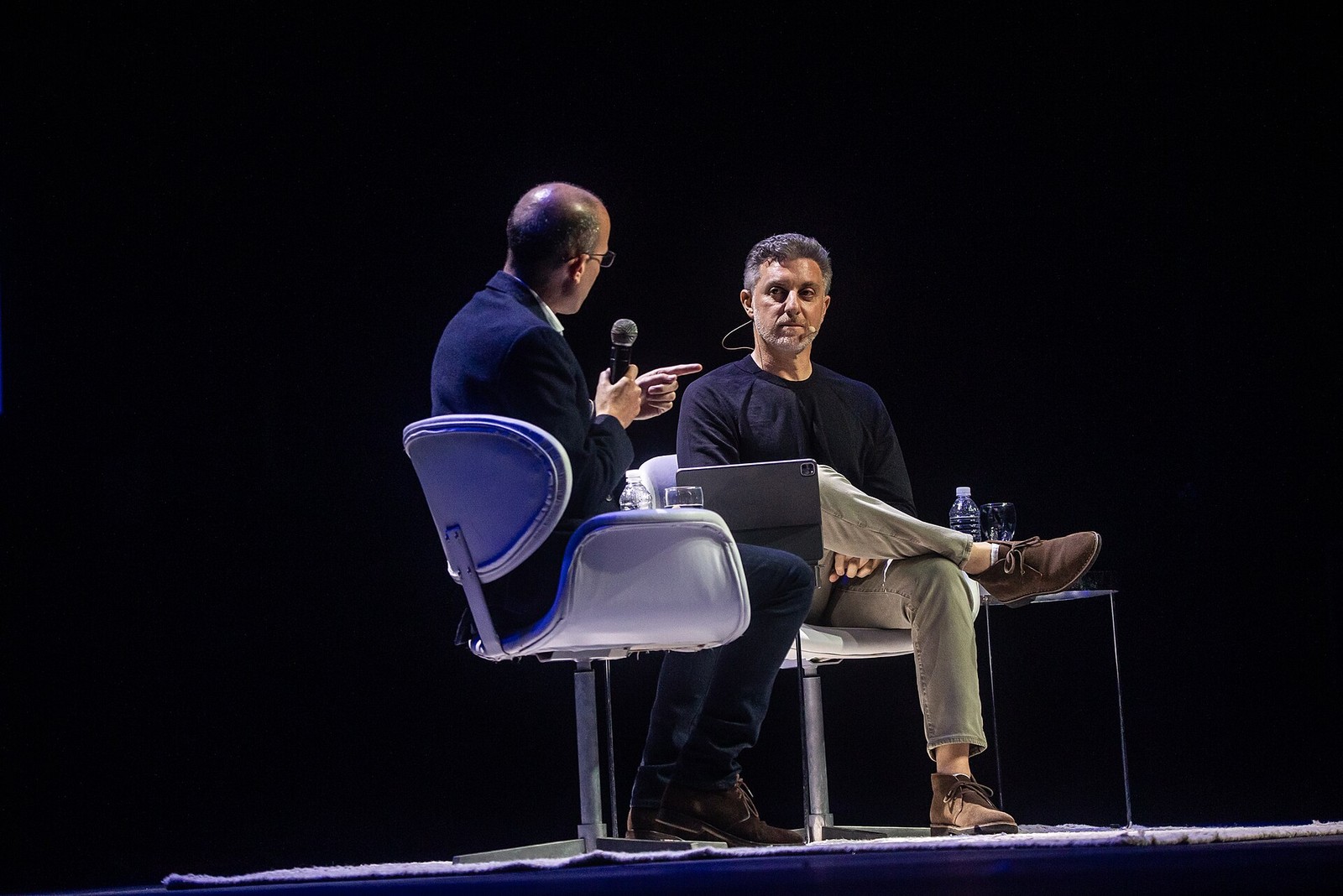
A knife can cut a salad or commit a murder, but it cannot choose between them. “It’s a knife that can decide by itself whether to cut salad or commit murder,” the historian said in an interview broadcast on Czech Television’s “Hyde Park Civilizace” in October, and that capacity to choose is where his argument about artificial intelligence begins.
The distinction can sound like semantics. Mr. Harari, who turned 50 this year, treats it as the foundation of everything that follows. A printing press has no aims of its own. A model that writes, plans and negotiates has something that functions like one, and its output cannot be listed in advance the way the output of a lathe can.
He reaches for an analogy he has used for years. Aircraft do not flap their wings; they fly by a logic birds never developed. Intelligence built on silicon, in his account, will not converge on the human kind. It will drift away from it. He calls it alien intelligence, which means not hostile but unlike us, and likely to grow more unlike as it improves.
That is also why the sums are so large. If AI could only do what people already know how to do, the money being committed to data centers, chips and power would be difficult to defend. The wager only pays if the systems produce things their builders cannot foresee. The same property that justifies the spending is the one that makes the systems hard to supervise.
His larger fear is not a robot with a weapon. It is paperwork.
Civilization runs on administration, he argues: tax codes, credit files, court dockets, insurance schedules, immigration forms. These are technologies for processing millions of people consistently, and they are the reason large-scale cooperation works at all. AI, in his phrase, is a “native bureaucrat,” a system that reads and writes the rules of that machinery more fluently than the clerks it replaces.
Then the rules begin to move faster than the people living under them can read. A model adjusts a threshold. A bank changes who qualifies for a loan. An agency reorders its queue. Each step is defensible on its own. Taken together they are not legible. He calls the result collective dementia: a society that keeps functioning while losing the ability to explain its own decisions.
The medical metaphor is doing real work. A patient with dementia is alive, and the body still runs; what fails is the map. A civilization in that condition still delivers electricity and clears payments, and still cannot say why one town kept its clinic and another lost it.
Mr. Harari is a professor of history at the Hebrew University of Jerusalem. “Sapiens,” published in Hebrew in 2011 and in English in 2014, sold tens of millions of copies and made him one of the most widely read historians alive. “Homo Deus” followed in 2016, “21 Lessons for the 21st Century” in 2018, and “Nexus” in 2024, a history of information networks that runs from cuneiform to large language models and ends with the warning he now repeats on stage.
The register has changed. In the earlier books, technology arrived as something people did to one another: empires, religions, money, all shared fictions held together by stories. In the past three years he has argued that AI is a participant in the room, and that the institutions meant to govern it were designed for tools that stay where they are put.
Not everyone buys the frame. Historians who have reviewed the books say the sweep comes at the cost of evidence, and that collective dementia describes a feeling rather than a mechanism. Technologists point out that bureaucracies were opaque long before software: a loan officer’s discretion was never auditable, and a filing clerk could bury an application without leaving a trace.
His answer is that the speed is new, and the scale with it. A rule of thumb that once changed when a ministry reprinted a manual now changes when a model is retrained, sometimes weekly, sometimes without an announcement. Nobody signs the change, which means nobody can be asked about it.
He offers one piece of evidence from his own life. He has described watching a fabricated video of himself for roughly 90 seconds before registering that something was wrong. The lesson he draws is not that people should be more careful. It is that verification will not become a mass skill, because the cost of checking rises with the quality of the fake.
The oversight gap is easier to state than to close. Europe’s AI Act is being phased in over several years. In the United States, rules arrive as a patchwork of state statutes and agency guidance. Evaluations of frontier models are still largely performed by the companies that build them or by contractors those companies pay, and no regulator can open a model the way an inspector opens a factory.
That is the part of the interview that will travel furthest in policy circles, because it is the part that can be acted on. A licensing regime, an audit standard, a liability rule that puts the cost of an unexplainable decision on the institution that deployed the system: each is a way to keep the map in human hands.
Mr. Harari does not expect any of them soon. His own view is that the technology is moving at the speed of capital, and that institutions move at the speed of legislation, and that the gap between the two is where the next decade gets decided.
The knife remains a useful image, because everyone knows what a knife is for. The difficulty begins when the object on the table has its own view of the matter.