Volkswagen’s answer to underused factories in China is to ship the parts out of them. The group has signed a letter of intent with Dogus Otomotiv, its distributor in Turkey for more than three decades, to explore assembling Volkswagen-branded passenger cars there from kits sent from existing plants.
Dogus disclosed the agreement in a filing to Turkey’s capital markets platform on Oct. 30. The company said the talks concerned higher-value products aligned with new technologies and support for the domestic auto industry, and gave no models, investment figure, capacity or timetable. A person familiar with the plan said it involves vehicles developed for the Chinese market by the FAW-Volkswagen joint venture. Volkswagen declined to comment.
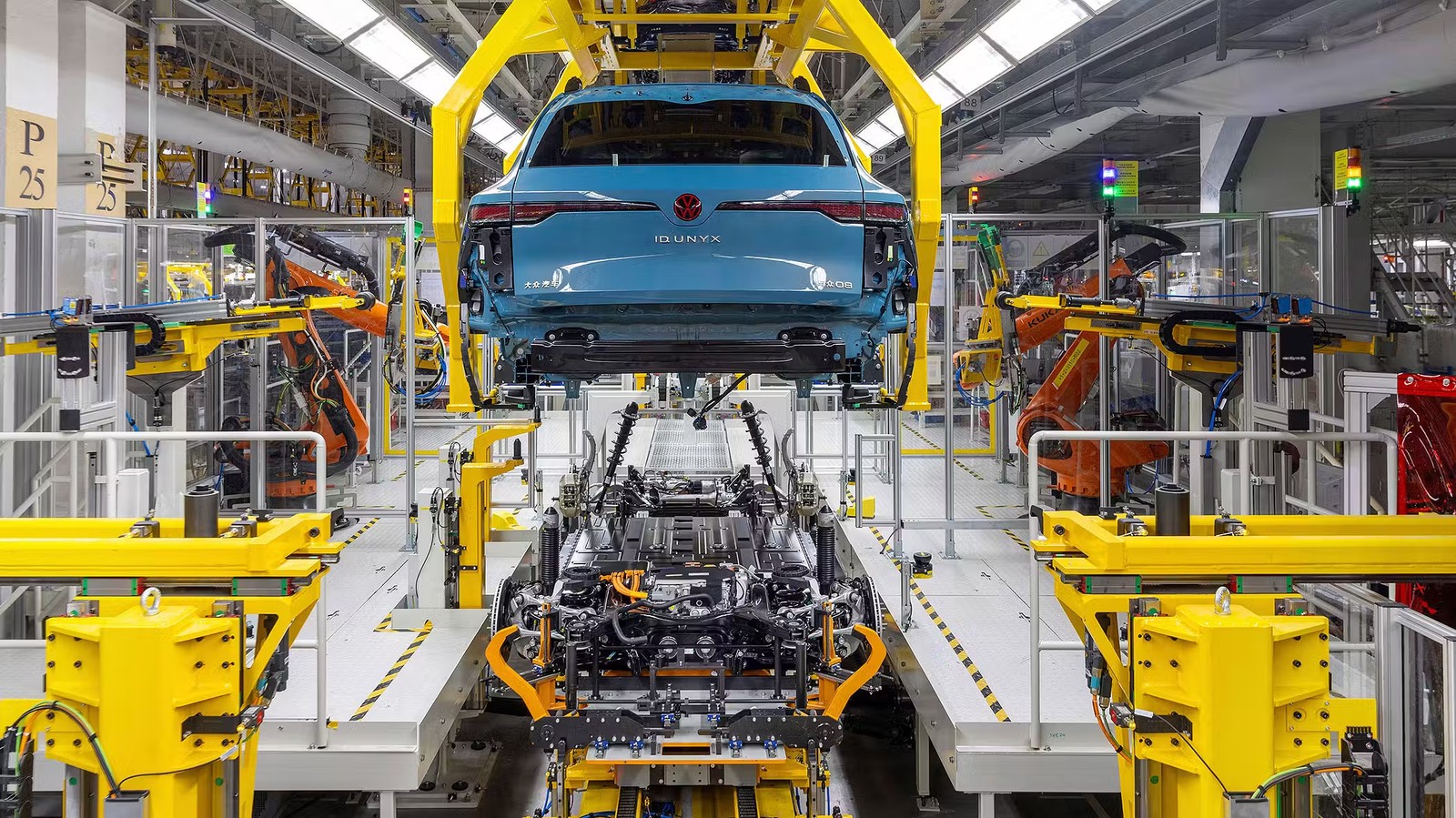
The method is completely knocked down assembly, known in the trade as CKD. A vehicle is broken into component sets at the plant that builds it, shipped as freight, and put back together near the customer. The advantage is that the expensive part of a car factory, the stamping and painting and the line itself, stays where it already exists. The destination country supplies labour, a shed and a market.
For Volkswagen the appeal is capacity it cannot fill. Its Chinese plants were built for a market that has cooled, and the group has been looking for ways to convert that idle capacity into export revenue without paying for new plants. Auto Motor und Sport reported that the models under discussion include the Magotan, the Passat variant sold by FAW-Volkswagen, along with vehicles from the Jetta and Audi brands. Volkswagen has told Turkish media that it is examining the export of partially assembled vehicles from non-European production sites for the local market, and has not said whether electric models could be included.
Turkey’s position in the European customs union is part of the calculation. Finished vehicles shipped from China to the European Union face countervailing duties that the bloc imposed on electric cars in 2024, on top of its standard tariff. Component sets arriving in Turkey and assembled there would enter the same customs territory under a different heading, which would let the group reach European and Middle Eastern buyers without paying the finished-vehicle rate. Turkish tariff rules on the kits still apply, and the saving depends on how much of a car’s value is added after assembly.
The economics of CKD favour models with a long remaining life and a modest volume. A kit avoids the tooling and the paint shop but adds freight, and the duty saving has to exceed the cost of shipping air and metal across the Mediterranean. That is why the candidates are older platforms with established suppliers rather than the group’s newest electric cars, which need battery packs assembled close to the line and local content that Turkey does not yet have.
The plan fits a strategy the group presented in Hefei at the end of October under the phrase “In China, Beyond China.” Volkswagen now describes its Chinese operations as a development and export hub rather than a supplier to one market. It already ships cars made in China to the Middle East, Uzbekistan, Kazakhstan and parts of Sub-Saharan Africa, with Mexico, Egypt and Vietnam due to be added by the end of 2026. The China Main Platform and the China Electronic Architecture are meant to underpin model lines in South America from 2030.
What the strategy does not solve is the cost problem at home. On Oct. 30 the group paused development of the electric ID Golf, citing cost pressure. Net cash flow at Brand Group Core fell to €1.43 billion in the first nine months of 2026 from €4.34 billion a year earlier. A memo circulated at Wolfsburg and reported in the German press put the gap between the plant’s costs and its targets at €300 million.
Turkey is familiar ground for a retreat. In 2019 Volkswagen planned a plant at Manisa, with investment of about €1.3 billion and capacity for up to 300,000 vehicles a year, building the Passat and the Skoda Superb. It abandoned the project in 2020, citing the pandemic and changed market conditions, and put the money into existing European sites instead. Dogus, which has represented the group since the 1990s and has lately expanded with Volkswagen into Iraq, Azerbaijan and Syria, would be the local partner this time rather than a greenfield investor.
For the group’s German workforce, the arithmetic is uncomfortable. Volkswagen has spent two years telling unions that capacity must come out of German plants to protect margins, while exploring assembly of Chinese-developed models for export. Every car built in Turkey from a Chinese kit is a car that does not need a line in Wolfsburg, and German labour leaders will judge the strategy by what it does to volumes at home.
None of this is settled. Dogus has confirmed only a letter of intent, and the parties have not decided whether assembly would serve Turkey alone or export markets as well. A final decision has not been taken, according to people familiar with the discussions.
The larger question is whether a European manufacturer can keep its German plants running while using Chinese engineering to compete on cost elsewhere. Volkswagen’s answer, so far, is to do both and hope the arithmetic works. The Turkish file will show whether the second half of that answer can be executed without the first half collapsing.