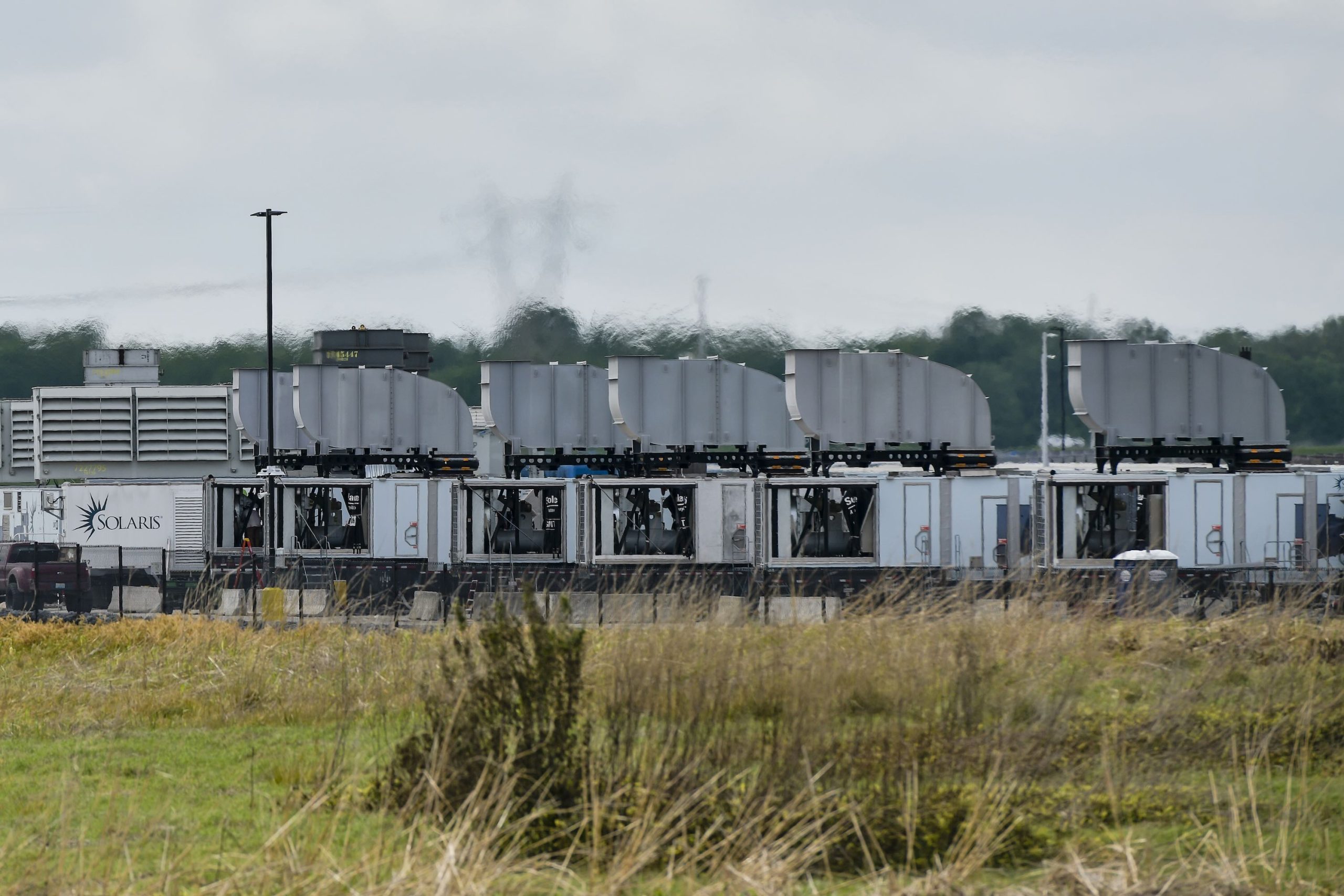
Eight generating sets built from retired airliner engines are now installed at xAI’s Mississippi site, where they supply power for the company’s Colossus 2 data center, according to a New York Times report on Nov. 3 that cited permit documents and satellite imagery. The state air permit sets an emissions ceiling at roughly a quarter of what the equipment would produce running flat out.
That single ratio carries most of the story. A permit written at a quarter of full load means the operator can run the engines hard for part of the year, or run them gently all year, or some combination the permit defines. It is a constraint on hours as much as on hardware, and it tells you the state approved the generation while limiting how much exhaust the site can produce.
The documentary trail is what makes the report more than a claim. Permit applications require an operator to state what equipment will be installed, how much fuel it will burn and what it will emit, and satellite images show whether the pads were built. A filing of that kind is a public commitment, and the gap between what a permit allows and what a site does is the thing regulators audit.
The hardware itself is a familiar trick in unfamiliar hands. Aircraft engines are designed to produce enormous power from a small package, and when an airframe reaches the end of its life the engine often has usable hours left. Converting one to burn gas on a concrete pad requires a cradle, a generator, controls and an exhaust stack, and the result can be delivered faster than a utility-scale turbine, which is ordered years in advance and built to order.
Speed is the reason the equipment exists. Grid connection queues in the United States now stretch to several years in the regions where data centers want to build, and a company that waits for an interconnection agreement is a company that waits for revenue. Behind-the-meter generation cuts the queue out of the critical path. TechCrunch noted on the same day that more data center developers have been buying used aircraft engines, a market signal that the workaround is spreading.
Mississippi’s attraction is the same as it has been for other large industrial projects: land, power and a state government willing to move paperwork. What is different is the scale of the load. A single AI campus can draw as much electricity as a mid-sized city, and the generation that supports it has to be permitted, fueled and maintained on a schedule that construction crews rarely respect.
Emissions are where the arrangement becomes contestable. Gas turbines produce nitrogen oxides, and the permit limit is the mechanism that decides how much. A cap at a quarter of full-load output implies either substantial idle time or operation at reduced power, and neighbors and regulators will watch which one it turns out to be. The permit also fixes the reporting the company owes, which turns the site into a public record of how the power was actually used.
The economics favor the improvisation for now. Grid power is cheaper per kilowatt-hour than power from a generator burning gas at a site, but it is not available, and the cost of delay for a data center is measured against the revenue from hardware that depreciates whether or not it is running. Companies in that position pay a premium for speed and account for it as part of the construction budget.
Maintenance is the part that does not appear in the announcement. An engine designed for an aircraft operates in a narrow envelope with a maintenance program written by its manufacturer. A stationary unit running continuously needs overhaul intervals, spare parts and technicians, and the supply chain for retired engines is a second-hand market with limited depth. If the fleet grows, the constraint may be the number of serviceable engines rather than permits.
Fuel is the constraint that follows the permit. A bank of engines needs a supply contract sized to its running hours, and gas delivered to a rural site may require a pipeline connection that has its own schedule and its own approvals. Operators can bridge the gap with trucked fuel, at a cost that rises with volume and with the number of deliveries a site needs each week.
The trend has a limit that is easy to see. Used engines are a finite resource, and the price rises as more buyers enter the market. A developer that builds a habit around them is exposed to that price, and to the possibility that a state decides the air permit terms were too generous. Utilities, meanwhile, have their own incentive to keep large loads on the grid where they can be planned for, rather than behind the fence.
For xAI, the calculation is straightforward in the short term. The company has committed to a large campus and needs power before the interconnection arrives. Eight converted engines, a permit and a fuel contract buy time. What they do not buy is a permanent answer, and the quarter-of-full-load ceiling makes clear that the state has not granted one.
The test will come in two places. The first is the operating record, which the permit makes visible. The second is the next site, because a company that repeats this approach in another state is telling regulators and utilities that the queue is not going to be tolerated. If the engines stay in Mississippi, the arrangement was a bridge. If they travel, the power industry has a new kind of customer.