
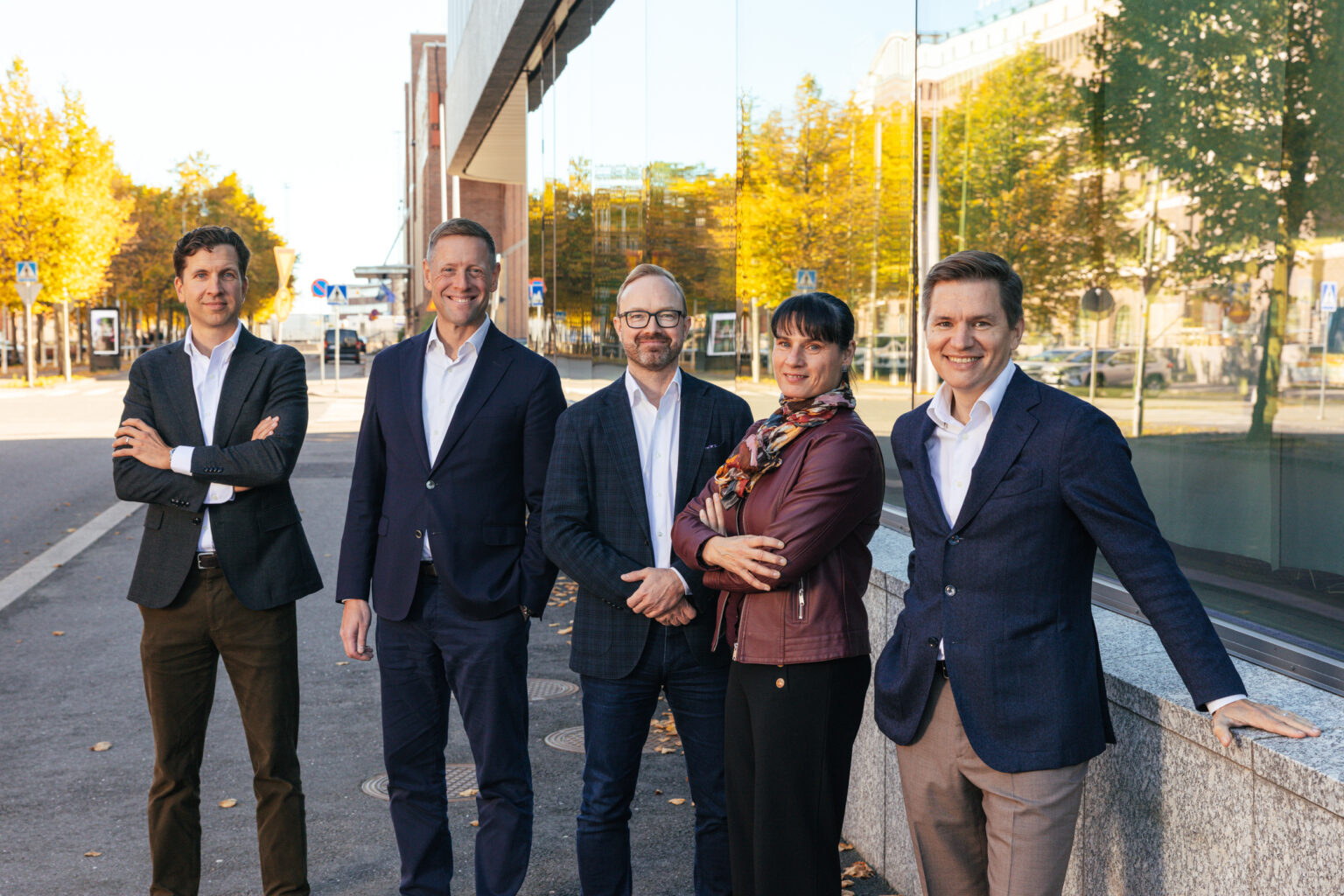
Intera Partners set out to raise €375 million. It closed at €450 million, the hard cap it had set for itself, 20% above the target and in roughly eight months. No Finnish buyout fund has been larger, and the timing is the unusual part: European fundraising has been slow for two years, with institutions committing less to private equity and asking harder questions about the distributions they have not received. Intera Fund V will do what the previous four did. It buys majority stakes in small and mid-sized companies in Finland and Sweden, mostly in services and technology, and it takes board seats and operating roles rather than minority positions. It does not buy heavy industrial assets and it does not invest at the venture stage. The firm has run that strategy for 19 years, and across five funds the size has grown each time without a down round.
That consistency is the product. Institutional investors allocate to private equity through a filter that has narrowed: they commit to managers they have backed before, in sizes large enough to matter to their returns and small enough that one fund cannot damage the portfolio. For a European mid-market firm the differentiator is not the pitch on the next fund. It is the evidence from the last one, and Intera’s evidence is a set of exits from companies that were small when the firm bought them and were sold to industrial buyers or to larger funds at a multiple that justified the entry price.
The scale is worth putting in context. €450 million is a mid-market vehicle by global standards, smaller than a single deal in the largest American buyout funds. That is the point rather than a limitation. The companies Intera targets, a services business with €30 million of revenue or a software vendor with a narrow customer base, are too small for the large funds to buy and too large for a founder to sell to management without outside capital. The segment exists because of that gap, and a fund that grows too far beyond it starts competing for assets where the returns are thinner and the prices are set by people with more money than discipline. Finland and Sweden supply a specific kind of opportunity. Both economies have a generation of owner-managed companies whose founders are between 60 and 70, and both have tax and legal systems that make a clean sale to a financial buyer straightforward. The pool of targets is finite. A fund of €450 million has to write cheques of €40 million to €80 million to deploy in a reasonable period, which means roughly eight to ten companies, which means the firm needs to see most of the available deals in its segment. That is a sourcing problem before it is an investing problem, and it is the constraint that keeps a Nordic mid-market fund from growing indefinitely.
The hard cap is a signal about demand rather than about ambition. A firm that closes above target in eight months has more commitments than it can accept without changing its strategy, and it chooses to protect the strategy. Funds that keep raising until the market stops them end up with more capital than deals, and the pressure to deploy shows up in entry multiples a year later, when the fund has to explain why it paid nine times earnings for a business that was worth seven.
The exit market is the risk. Nordic buyouts depend on strategic buyers and on a functioning IPO window, and both have been unreliable since 2022. A fund that buys at seven times earnings and sells at nine needs the second number to arrive within five years, and the companies Intera buys are exposed to the same slowdown as everyone else. Services businesses with recurring revenue have held up. Businesses tied to construction, to industrial production or to consumer discretionary spending have not, and the difference between those two groups is the difference between a good vintage and a mediocre one.
The other risk is internal. Five funds and 19 years is a long record, and it is also an aging one. The partners who built the franchise will eventually leave, and the next generation has to raise Fund VI on its own results rather than on the reputation of the people who hired them. Investors who re-upped into Fund V were backing a team as much as a strategy, and the largest cheque in the firm’s history is the moment when that backing is most concentrated and least tested.
There is a broader reading that applies beyond Helsinki. European mid-market buyouts have been consolidating for a decade, with the largest firms raising ever bigger funds and the smallest struggling to reach a first close. A national champion in a country of 5.6 million people closing at its hard cap in eight months is evidence that the segment is not dying. It is evidence that the investors who fund it have become more selective, and that being the obvious choice in a small market is worth more than being the fourth choice in a large one.
None of this argues against the raise. It argues that the number to watch is not €450 million. It is the pace of deployment over the next 24 months and the entry multiples the firm accepts when it has capital committed, a mandate to put it to work, and a market that knows exactly how much it has to spend.



