
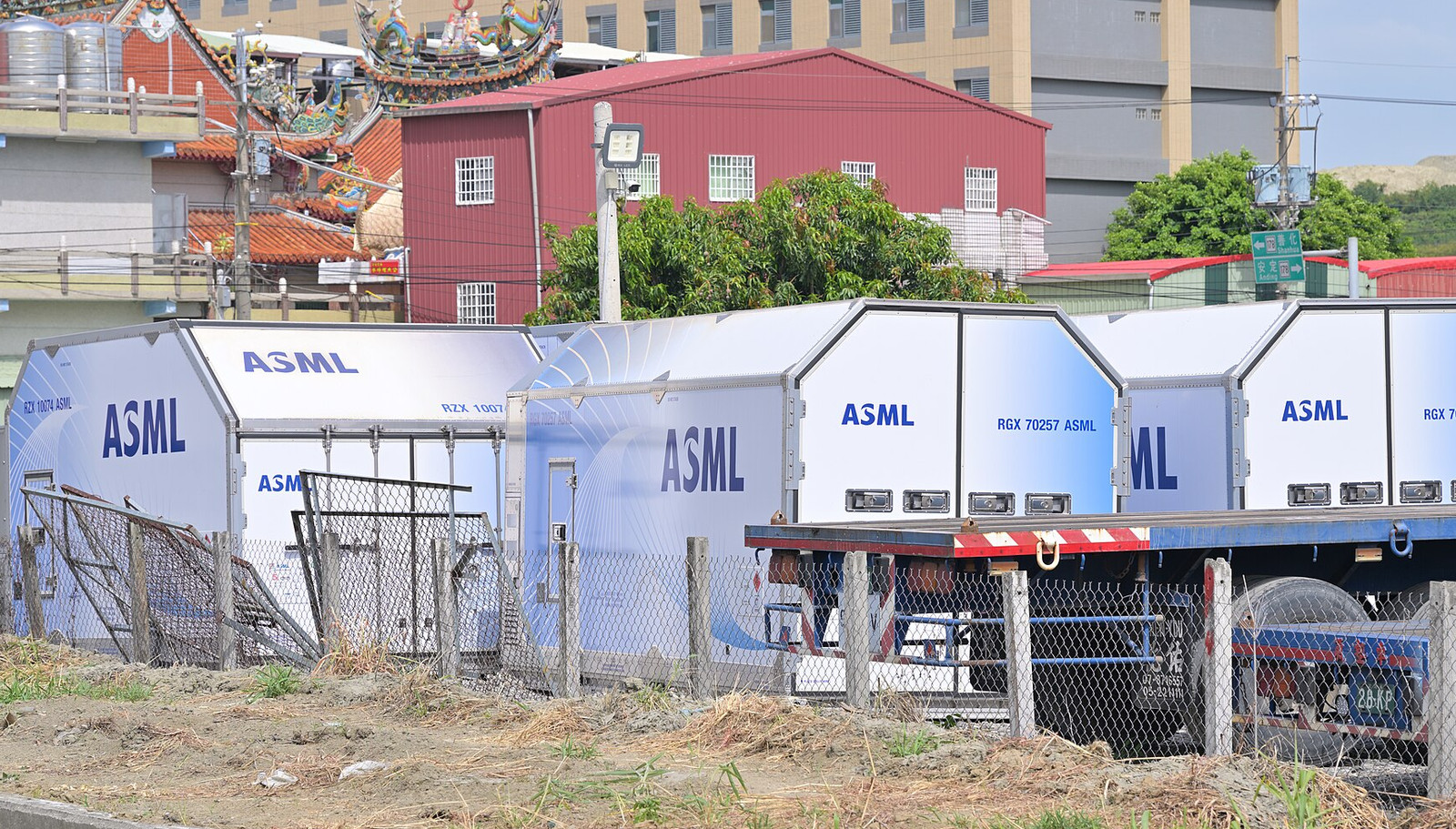
The number that matters in the memory business this week is not a price. It is a delivery date. Samsung Electronics and SK Hynix are each preparing orders with ASML worth 10 trillion to 20 trillion won, according to industry figures reported in Korea on Nov. 8, a range of roughly $7 billion to $14 billion per company for the lithography machines that pattern the most advanced chips. SK Hynix has already put part of its number on the record. In March the company disclosed an order of about 11.95 trillion won, with delivery running to Dec. 31, 2027, among the largest single equipment orders the industry has announced. The disclosure gave suppliers and rivals a rare look at how far ahead the memory makers are planning, and how much of the constraint sits with one Dutch company.
ASML has been blunt about that constraint. On its third-quarter call this year, management said the supply it has planned for 2027 and 2028 will not meet customer demand. Shipments of extreme-ultraviolet machines will reach about 65 units this year, up nearly 50% from 44 last year. Even with capacity up 30% in 2027, and another 30% expansion under review for 2028, the company said the total would fall short. Lead times on the most sought-after tools have as much as doubled.
The machines are the bottleneck because they are close to unbuildable at scale. Each low-NA EUV system lists above $150 million, carries optics from Carl Zeiss that take months to polish and coat, and draws power at a rate that requires dedicated substations at the fab. The high-NA versions that follow cost more than twice as much and are larger than a shipping container. A customer that wants fifty tools is asking for a substantial share of a year’s global output, and the allocation is negotiated rather than ordered.
For memory the calculus changed later than it did for logic. Samsung has used EUV in DRAM production since its first EUV-based node, and has pushed the technology into more layers at each step. SK Hynix was more conservative, relying on multiple patterning longer, and is now moving to EUV for its most advanced DRAM and for the base die that sits under high-bandwidth memory stacks. That base die is where the competition is sharpest: it is the piece of an HBM module that can be made on a logic process, and it is where performance gains are now being found as the memory dies themselves approach physical limits.
The order sizes make sense against that shift. An order of 20 trillion won works out to dozens of machines at current prices, which is what a company needs if it intends to convert a meaningful share of its DRAM output to a process that depends on EUV. Neither company has published a total for the orders or said where the tools will be installed; the figures circulating in Korea come from suppliers and industry officials rather than from the companies.
There is a financial dimension that was not present a few years ago. Samsung ended the third quarter with 214.8 trillion won in cash and short-term financial assets, and SK Hynix has been generating cash at a rate it has not seen since the last memory upcycle. Both can afford the orders. The question for shareholders is whether they should place them all at once, at a moment when every large buyer in the industry is trying to do the same thing.
The risk in a queue is that it overstates demand. When delivery slots are scarce, customers order more than they need to secure position, and the orders that get canceled are the ones furthest out. ASML’s backlog has historically included some of that inflation, and analysts who follow the company have warned that a portion of the 2027 book reflects defensive ordering rather than capacity that will be installed. The memory makers have an incentive to let that impression stand, because a long queue is also a warning to rivals. The deeper risk is timing. Machines ordered now arrive in 2027 and 2028, at the end of a two-year buildout of AI data centers whose demand assumptions are being revised every quarter. A lithography tool is a ten-year asset with few alternative buyers; if the memory market turns, the capacity it creates does not disappear, it waits. The last cycle taught both companies that lesson at a cost of tens of billions of dollars in writedowns.
For ASML the position is enviable and awkward. It sells into a shortage it cannot relieve, which gives it pricing power and makes it the target of every government that wants chip capacity on its own soil. Export controls already limit what it can ship to China, and the capacity it does have is being allocated among customers who are also strategic allies. The company has said it will expand where it can, and that the supply chain around it, not its own assembly lines, sets the pace.
What the Korean orders show is where the constraint in the AI buildout has moved. Capital is available, governments are subsidizing, and the customers have the cash. The scarce item is a machine that takes more than a year to make and a slot in a queue that now stretches into 2028. Samsung and SK Hynix are not racing each other for market share in the ordinary sense. They are racing for positions in a line.



