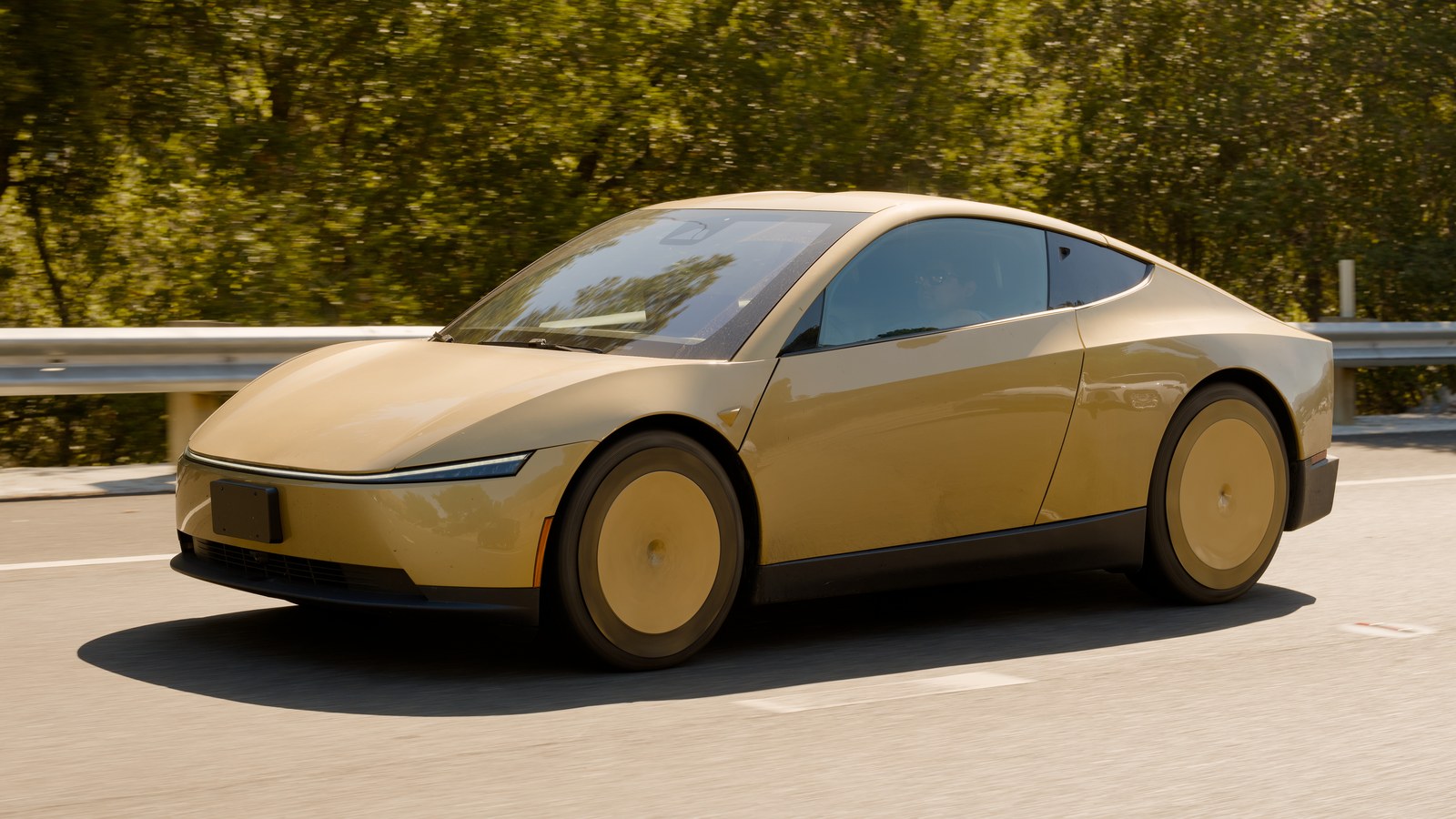
Forty kilowatt-hours is roughly what a compact hatchback carried a decade ago, before batteries got cheap and every manufacturer started advertising range as a virtue. Elon Musk said this week that the Cybercab will use a pack of that size, alongside a new paint colour called Liquid Silver.
He gave no timetable and did not say whether the figure replaces an earlier specification. Tesla has never published the capacity of the vehicle at all, which makes the number less an update than the first data point anyone outside the company has been given.
For a car sold to a household, 40 kWh would be a compromise: enough for a week of commuting, thin on a long drive, dependent on where the chargers are. For a robotaxi the arithmetic runs the other way, because the vehicle is not bought to satisfy a driver’s range anxiety. It is bought to move paying passengers for as many hours a day as possible.
That reframing explains the decision. Range is a function of pack size and efficiency, and a two-seat vehicle with a low frontal area does not need a large pack to travel a useful distance. At five miles per kilowatt-hour, a figure in line with what Tesla has claimed for a purpose-built robotaxi, 40 kWh works out to about 200 miles. No operator of a city fleet needs more than that between charges. The car comes home to the same depot every night and charges on a schedule the operator controls.
The economics of a fleet turn on three numbers: the price of the vehicle, the cost of the energy it consumes, and the share of the day it is available for hire. A smaller pack improves the first two and threatens the third. Fewer cells means a cheaper car, less mass to haul and better consumption per mile. It also means more charging events per day and less slack when a trip runs long. Every hour a robotaxi spends on a cable is an hour it earns nothing, while the capital cost of the car is being depreciated through that hour regardless.
Which is why the pack size is really a statement about charging infrastructure. A 40 kWh pack charged at a high rate can return to service quickly, but only where the depot has enough power and enough stalls to keep a fleet cycling. Tesla has spent a decade building a network for its own drivers; a depot for driverless cars is a different build, with different grid connections and different queueing. If the stalls are there, small packs are cheap and elegant. If they are not, the fleet will spend its afternoons waiting.
Musk’s admission about the Cybertruck is the more revealing part of the same conversation. He said the truck is being discontinued because the company has a limited number of capable engineers and limited floor space, and that keeping a complicated line running would slow the Cybercab ramp. That is not a demand story or a strategy story. It is a statement about capacity, and it means Tesla is reallocating people rather than hiring more of them.
The same logic applies to the pack. A 40 kWh design uses fewer cells, which matters when cell supply is the constraint that decides how many vehicles come off a line. Tesla has spent years arguing that its own cell programme would give it an advantage in cost; a smaller pack stretches whatever volume that programme delivers across more cars. The company gets more robotaxis per gigawatt-hour, which is the number that governs a fleet business. Colour announcements usually signal something else, though. A new paint option is a cheap way to keep a product in the news between engineering steps, and Liquid Silver arrived attached to a battery figure rather than a launch date. Tesla has been showing the Cybercab without saying when production begins, at what price, or how a vehicle designed without a steering wheel and pedals clears the federal safety rules that assume both. Those omissions matter more than the pack. A robotaxi business requires a manufacturing line, a regulatory exemption, a charging depot and a dispatch operation, and Tesla has disclosed none of them in commercial detail. A battery capacity is one line in a specification sheet, and it is the easiest line to release.
What the 40 kWh figure does confirm is the shape of the intended product: short trips, low speed, high utilization, home base charging. That is a defensible design for a machine that never leaves the city, and it is cheaper to build than the packs that dominate the current line-up. It is also a bet that the charging network, not the battery, is where the money goes. Whether the bet pays depends on something Musk did not mention. A pack chosen for efficiency assumes a vehicle that spends its life in mild weather, on predictable routes, close to a depot. Fleets in Phoenix will be fine. Fleets in cities with ice and salt will lose range in exactly the months when demand for rides peaks, and the operator will discover that a small pack is a seasonal asset.