The processor that matters in an AI cluster is usually not the one on the poster. Behind every rack of accelerators sits a set of ordinary server chips whose job is to feed them, and the company that wins that job wins a quiet, recurring share of every deployment.
AMD said on Nov. 9 that its fifth-generation EPYC server processors will serve as the host infrastructure for TPU 8tx, the Google Cloud system the two companies described as the first cloud TPU offering hardware-enforced confidential computing. The arrangement combines AMD’s processors and its Infinity Guard security features with Google’s accelerator to run inference, fine-tuning and reinforcement learning workloads while keeping customer data isolated.
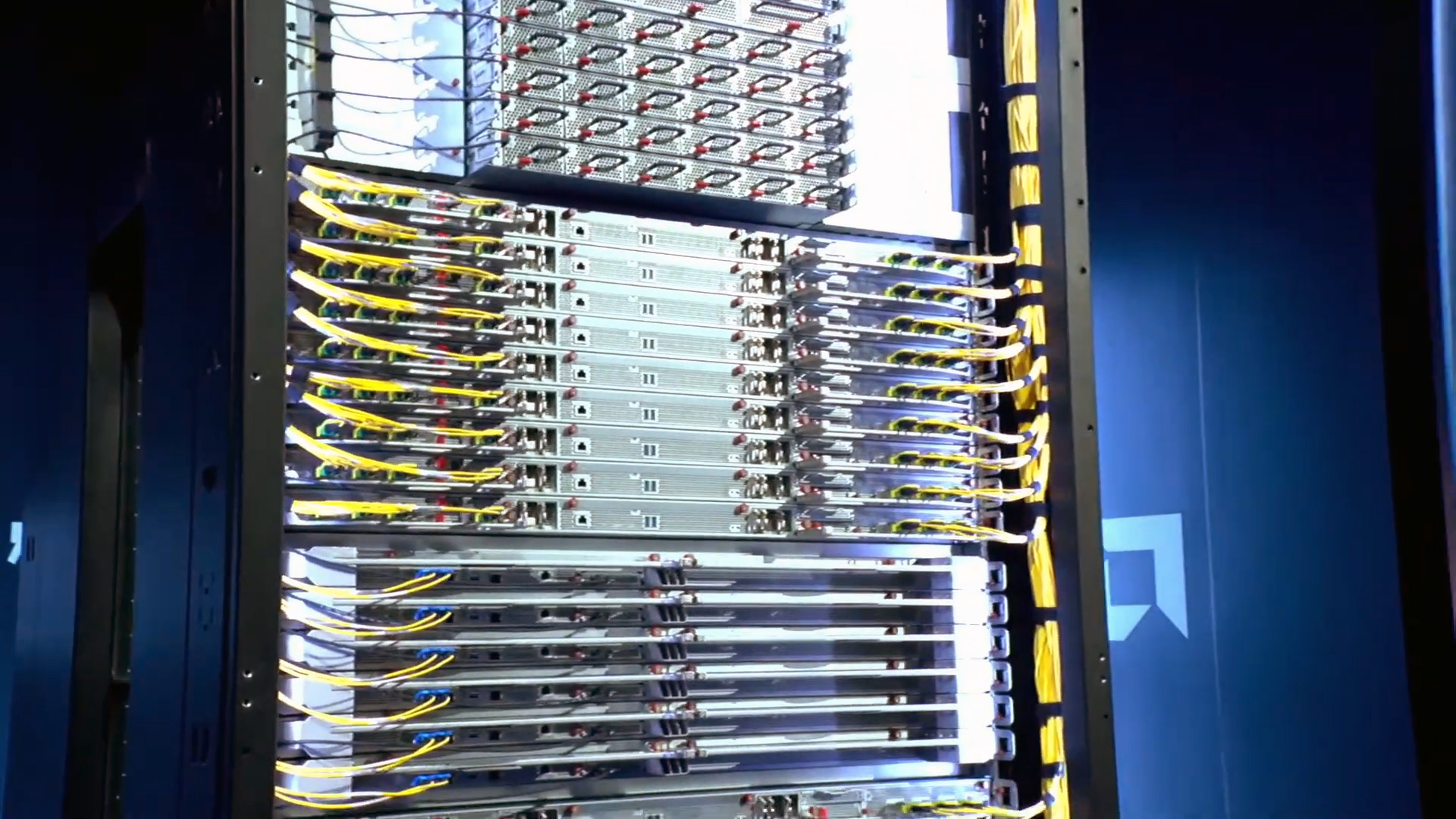
Host CPUs are the part of an AI system that gets the least attention and does the most chores. They hold the operating system, manage memory and storage, schedule work onto the accelerators and handle the network interfaces. A rack of accelerators is, in effect, a small cluster of servers with an unusually expensive peripheral attached, and the quality of the host layer determines whether the expensive part stays busy.
Confidential computing is the specific claim here, and it is a harder problem at rack scale than on a single virtual machine. The technique encrypts memory so that the cloud provider’s own operators cannot read it, and it requires cooperation across the CPU, the accelerator and the hypervisor. Google Cloud has offered confidential virtual machines for several years, built on AMD’s memory encryption technology and on Intel’s equivalent, but extending the guarantee to a machine learning workload means the data, the model and the intermediate results all have to stay inside the protected boundary.
That boundary matters most for the customers who have the least ability to accept a leak. Banks running fraud models, hospitals training on patient records, governments processing classified material and pharmaceutical companies working on molecules all have data they cannot legally move into a shared tenancy without contractual guarantees. A training cluster that cannot offer those guarantees excludes them.
AMD’s position in the host slot is not accidental. The company has spent a decade converting a small share of the server market into a substantial one, and its pitch has been core count, memory bandwidth and power efficiency per rack. Those are precisely the metrics that matter when a CPU’s job is to keep accelerators fed without consuming the power budget the accelerators need.
The competitive threat comes from a different direction. Nvidia has been selling its own Arm-based server processor alongside its GPUs, on the argument that a tightly coupled CPU and GPU design removes bottlenecks. That approach works best for customers buying Nvidia’s full platform. Google builds its own accelerators, which makes it a natural buyer of merchant CPUs from someone other than the company it competes with in cloud AI.
AMD also said its EPYC processors have become the host CPU of choice for more than ten major hyperscale cloud providers and frontier AI labs. That claim is difficult to verify from outside, and the definition of choice is loose, since most large clouds run several processor families at once depending on workload. It does indicate that the company is no longer an alternative vendor but a default one in a category it once barely occupied.
The Google relationship has history. Google Cloud was among the earliest large deployments of EPYC, and the two companies have co-designed products around Google’s infrastructure before. AMD has also been the supplier behind several of Google’s confidential computing offerings, which made the TPU pairing a shorter step than it would have been from a standing start.
What the announcement does not disclose is volume. Host CPUs are a small fraction of the bill of materials for an AI system, but they are sold in large quantities and replaced on a predictable cycle, and the cumulative revenue from a multi-year platform commitment can be significant. AMD did not provide shipment figures or a value for the arrangement.
The larger question is whether the AI buildout will remain a market where the accelerator vendor sets the terms. Google’s TPU program exists partly to reduce dependence on Nvidia, and it depends on a supply chain it can shape. Choosing AMD for the host layer is consistent with that aim. Choosing a host CPU that is compatible with standard server software also keeps Google’s options open in a way that a proprietary pairing would not.
For AMD, the deal is another data point in a shift that has been underway since the first EPYC generation: the server processor market has become a two-vendor contest again, and the second vendor is now the one with the momentum. The company’s challenge is that its customer base is increasingly concentrated in a handful of buyers who design their own silicon and negotiate hard.
Whether confidential computing becomes a standard requirement for AI infrastructure or remains a premium feature for regulated industries will determine how much the positioning is worth. Google and AMD have both bet that it becomes standard. The customers who need it most have not yet finished migrating their workloads to the cloud at all.