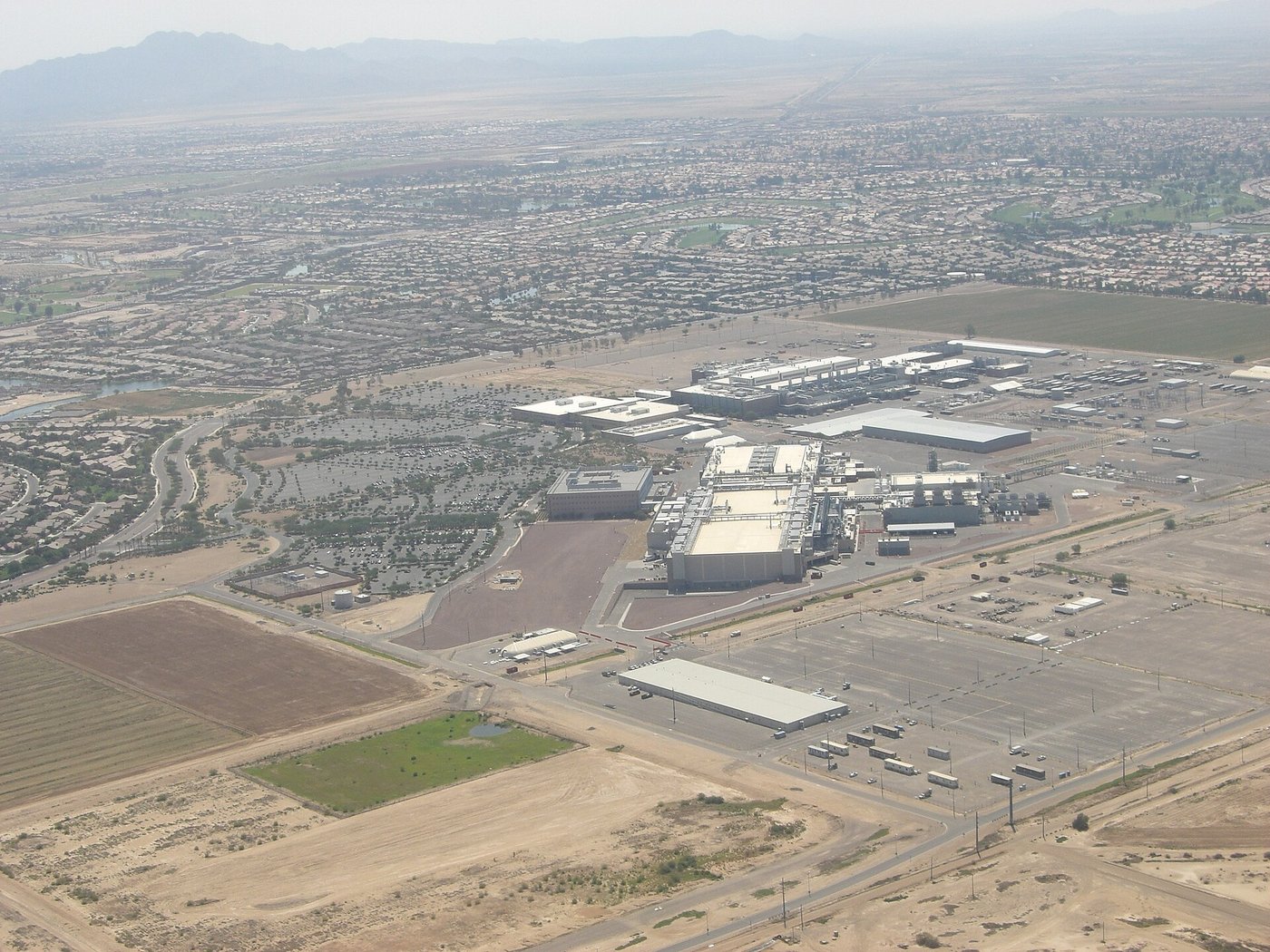
CHANDLER, Ariz. — The Ocotillo campus spreads across desert on the southeastern edge of this Phoenix suburb in a way that makes Intel’s ambitions legible from the road: rows of fabs, switchyards, a water reclamation plant and, at the far end, ground that has been scraped and graded but not yet filled with tools.
On Nov. 9 the company said it is accelerating construction of a new chip factory at that site, with production targeted for 2028. Ocotillo is Intel’s largest manufacturing base in the United States. The pace of the build is tied to two things the company controls less than shareholders would like: whether its process roadmap lands on schedule, and whether outside customers commit to fill the capacity once it exists.
Intel has been building at Chandler for decades, and the site carries the company’s recent history in physical form. The fab that opened there most recently is where Intel has been running its 18A process, the node it has described as the most advanced logic technology manufactured in the United States. Work on the next node, 14A, is underway, and the company has said that decision points on later fabs depend on customer demand rather than on a calendar.
That is the awkward arithmetic behind a construction schedule. A leading-edge fab takes years to build and months to qualify, and the equipment inside it is ordered long before the concrete is poured. Intel has adopted what it calls a shell-first approach: pour the structure, finish the exterior, install utilities, then hold the cleanroom empty until the process is ready. The strategy compresses the interval between a node being declared mature and wafers coming out the other end. It also spends capital years before revenue arrives.
For most of the past two years, Intel’s problem has been the opposite of too little capacity. The company spent heavily on new plants in Ohio and Arizona while its market share in servers eroded and its foundry business posted losses. The correction that followed involved slower spending, layoffs and a reconsideration of which projects would proceed on which timeline. A decision to accelerate at Chandler is a statement that the constraint has moved from cash to credibility.
Credibility is the currency in the foundry business. Customers who design a chip for a specific process need to know the line will be running when their product is ready, and they need to see yields they can model. Intel has signed commitments from Microsoft and Amazon’s cloud unit for 18A work, and it has taken outside investment, including an equity stake from the U.S. government and money from Nvidia and SoftBank. Those arrangements buy time and political cover. They do not buy volume.
Ohio is the contrast that makes Chandler legible. Intel’s campus outside Columbus, announced with fanfare and politically important to two administrations, has slipped repeatedly and is now aimed at the end of the decade. Arizona kept its schedule. A company with finite capital and a finite supply of process engineers has to choose where to concentrate both, and the answer has been the site with the existing supply chain, the existing workforce and the existing water deal.
The competitive context is unforgiving. TSMC has been building in north Phoenix, close enough that the two companies now recruit from the same pool of technicians and draw on the same water infrastructure. Samsung is building in central Texas. The federal incentive money that helped fund all three came with expectations that leading-edge logic would be made on American soil, an objective that requires at least one of these projects to succeed commercially rather than merely to exist.
Chandler has its own constraints. Water in the Salt River Valley is a political subject, and Intel’s reclamation arrangement with the city, which returns treated water to the aquifer, was structured in part to keep the campus from competing with residents for supply. Construction at this scale brings thousands of trades workers into a metro area that has been building apartments and data centers at the same time. Local officials have generally welcomed the expansion, and the tax base it produces, while residents have grown more attentive to what the industry costs them.
What the schedule change does not answer is who fills the plant. Intel’s foundry order book is thinner than the capital program implies, and the company has been candid that a large external customer is the difference between a viable second source and an expensive hedge. Every quarter that passes without one makes the 2028 target look less like a plan and more like a reservation.
There is a version of this story in which the acceleration is vindicated. Demand for AI accelerators keeps pushing advanced packaging and leading-edge logic into shortage, TSMC’s overseas capacity remains committed years out, and governments pay a premium for supply that does not cross the Pacific. In that world Chandler runs full and the shell-first gamble looks like discipline.
There is another version in which the plant opens into a market where the customers have already chosen. Intel has lived through that version once.
The difference between them will be visible in equipment orders, which are placed well before 2028, and in the customer names the company is willing to put in writing. Until then, the most concrete fact on the ground in Chandler is a graded patch of desert with a schedule attached to it.