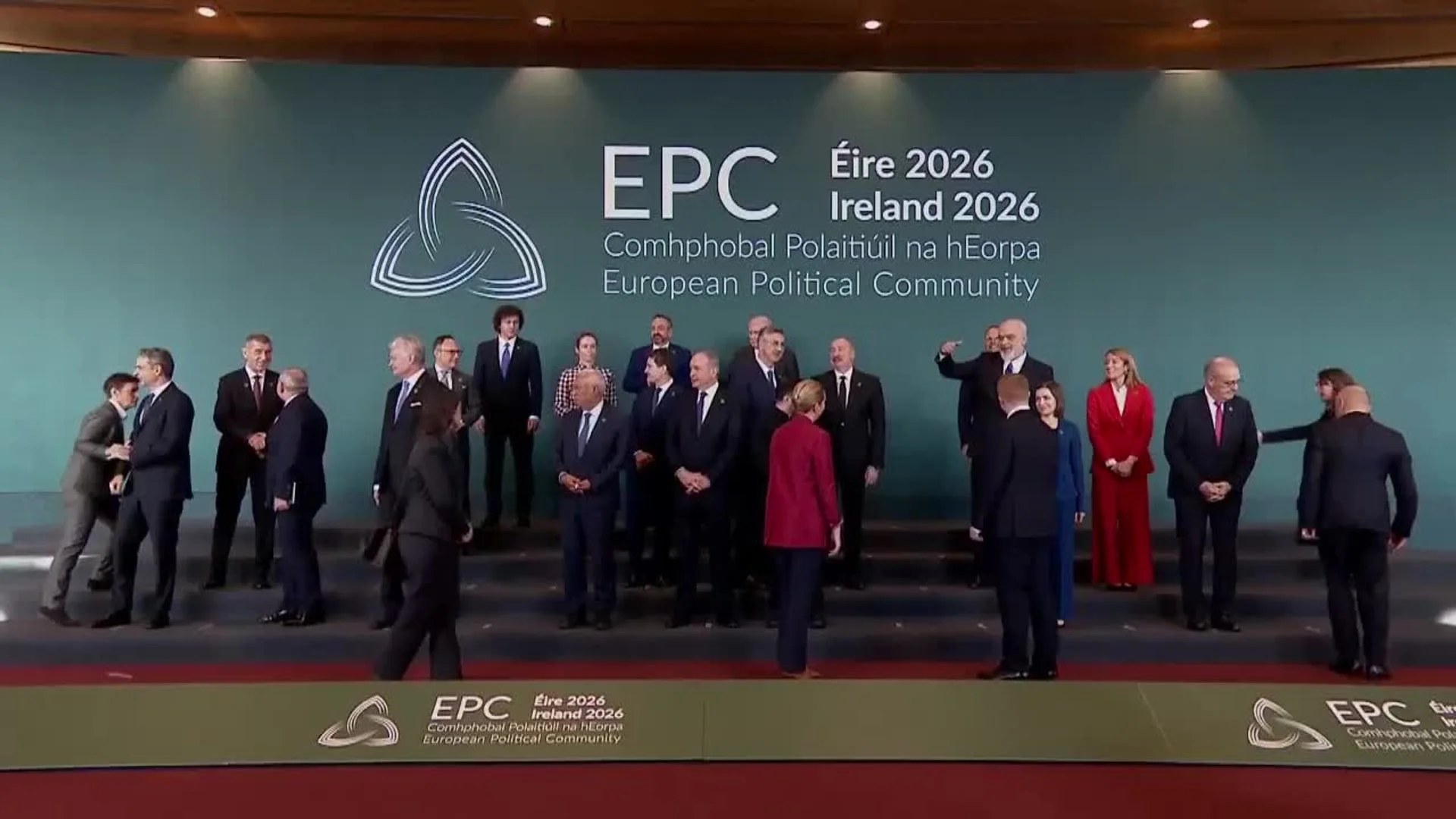
The Convention Centre Dublin sits on the north bank of the Liffey, and the streets around it have been closed for three days. Gardai have mounted the largest security operation in the history of the Irish state for a meeting at which, on Thursday, about 50 heads of state and government will discuss security, and at which, on Friday, 27 of them will discuss artificial intelligence.
The sequencing is the story. Thursday’s gathering is the ninth summit of the European Political Community, an informal forum created in 2022 after Russia’s full-scale invasion of Ukraine, and its theme is “Europe, strong, secure and connected.” Volodymyr Zelensky, Canadian Prime Minister Mark Carney, NATO Secretary-General Mark Rutte and European Commission President Ursula von der Leyen were expected at the convention center, with Ukraine and hybrid threats at the top of the agenda.
Friday’s meeting is different in kind. It is an informal meeting of EU heads of state and government, chaired by European Council President Antonio Costa and hosted by Taoiseach Micheal Martin, and its subject is AI. In his invitation letter of Nov. 3, Costa wrote that he believed it would be the first discussion at leaders’ level in the Council on the opportunities the technology presents and on its effect on Europe’s economies and societies. A decade of regulation had been negotiated largely below that level.
The agenda, set out in a steering note circulated with the letter, has two parts and two speakers. Arthur Mensch, co-founder and chief executive of the French model developer Mistral AI, and Geoffrey Hinton, the Nobel laureate who left Google in 2023 to speak more freely about risk, were invited to present. The first session covers competitiveness and what the note calls AI sovereignty: computing, cloud, models and chips, the adoption of AI by small and midsize companies and public administrations, and how to mobilize public and private money.
The second session covers consequences. Labor markets and the nature of jobs, fundamental rights including privacy and the protection of children, the integrity of elections against AI-generated disinformation and foreign interference, and cyber risk to critical infrastructure. It closes with the international governance of advanced models and what Europe should contribute to it.
The order matters. Competitiveness comes first because the diagnosis in the note is economic. Europe, it says, has world-class research, a dense startup scene and skilled people, and remains heavily dependent on non-European providers across the digital value chain, from computing power and advanced AI models to semiconductors, cloud infrastructure and software. The question put to leaders is not whether to act but which capabilities must sit inside Europe.
Answered honestly, that question implies choosing. The note asks leaders how to fund “large, high-risk investments where European investors cannot yet follow, and non-EU capital often takes over,” and points to the next multiannual budget and a new European Competitiveness Fund as the instruments. It also names affordable clean energy as a precondition, which flags the constraint that has shaped every European data-center decision this year.
The venue adds a second layer. Ireland holds the rotating presidency of the Council and has built its six-month program around regulatory simplification, including a digital omnibus that would amend parts of the General Data Protection Regulation and the AI Act. Critics of the package argue that it trades protections for speed. Ireland’s own AI summit in Dublin last month was dominated by industry speakers, with no civil-society organizations on the program.
That is the tension the two sessions embody. The bloc spent the years before this term writing rules for AI and has now found that rules do not produce models, chips or gigawatts. The first session asks how to build; the second asks how to keep what is built under control. Both are asked in the same afternoon, by the same 27 people, who will leave without adopting conclusions, because informal meetings do not produce them.
Security is the reason the two days were scheduled together. European governments are contending with a rise in cyber and hybrid attacks, and Irish officials have said they suspect a recent escalation in incidents in the country is linked to the presidency and to these meetings. Two United Nations special rapporteurs wrote last week questioning the independence of Irish regulators, who enforce European digital rules against most of the largest technology companies.
For companies the practical read-through is about money rather than principle. A discussion among leaders about sovereign computing capacity, if it turns into procurement, is a customer. A discussion about safety and global governance, if it turns into legislation, is a compliance cost. The steering note leaves both open, which is what an informal meeting is for.
What emerges is a direction, and the direction will be priced when the budget is negotiated and when the Commission brings forward whatever follows the digital omnibus. The question the leaders leave Dublin with is the one the note poses in its first paragraph and does not answer: whether sovereignty means buying European, or building it.