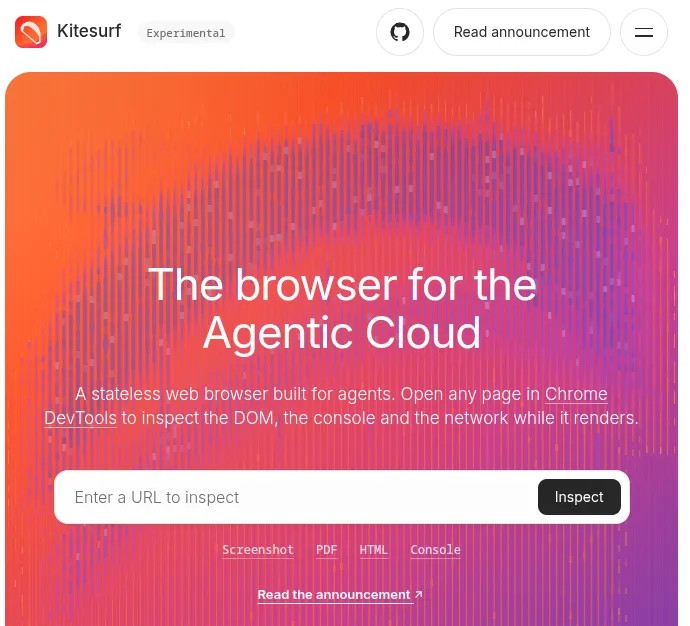
On Nov 13 a new repository appeared with an Apache 2.0 licence header and a short README, the kind of release that Cloudflare publishes several times a year and that developers usually bookmark and forget. This one describes a browser written for software agents rather than people, and it runs entirely on Cloudflare’s Workers platform rather than on a desktop.
The name is Kitesurf. It is stateless by design: each session exists to complete one task and is discarded when the task ends, with no profile, no cookie jar carried forward and no browser window left open behind it. Cloudflare said the point is to give an agent a way to reach the web without dragging a full operating system’s worth of software along with it.
That is a real problem, and it is not the one most people assume. Running a headless Chrome instance costs memory, startup time and management overhead, and an agent that needs a thousand pages pays for all three a thousand times. Sessions also accumulate state, which is useful for a human logging into a bank and dangerous for a program that may be steered by whatever text it reads on the page.
Kitesurf’s answer is to treat the browser as a function call. A task arrives, the runtime loads a page, extracts what it needs, and the session is torn down. Because the execution environment is Workers, there is no persistent machine to patch, no pool of browsers to keep warm, and no state to leak between customers.
Cloudflare said developers can read the code, change it and deploy it to their own accounts. That last part is the commercial argument as much as the technical one. A company that will not send customer data through a vendor’s browser can run the same software inside its own Cloudflare tenancy, and the vendor still bills for the compute.
The licence choice supports that. Apache 2.0 permits commercial use and modification, and it includes an explicit patent grant, which matters to enterprises whose legal departments have learned to ask about it. A copyleft licence would have made the code readable but awkward to embed; a source-available licence would have made it readable and unusable.
The timing is not accidental. Agents that book, buy, fill forms and compare prices have moved from demonstration to procurement in the past year, and every team building one has had to answer the same question about how the agent touches a web page. Some use APIs where they exist, most fall back to a browser where they do not, and the fallback is where the cost and the risk concentrate.
Cloudflare’s business sits underneath that fallback. Workers is billed by request and duration, so a stateless browser that runs there converts agent traffic into metered usage. Opening the client software costs the company nothing directly and puts its runtime in front of developers who might otherwise build on a competitor’s headless-browser service.
The design has limits that will show up in production. Stateless sessions are poor at anything that requires a login maintained across steps, and a great deal of the useful web still assumes a returning user. Sites that render slowly, sites behind bot detection and sites that require a second factor will not care that the runtime is elegant.
Security is the other edge. An agent reading a page is exposed to whatever instructions that page contains, and a disposable session limits how far a hijacked task can reach but does not stop the agent from doing the wrong thing once. Cloudflare has published guidance on isolating agent workloads; the licence lets security teams check the implementation for themselves rather than take it on faith.
The economics of that model favour the vendor in one direction and the customer in another. A per-request browser is cheap when an agent finishes a task in a few page loads and expensive when it wanders, which pushes developers to write agents that know where they are going rather than agents that explore. That constraint is a design opinion as much as a billing arrangement.
The competitive field is crowded and unsettled. Headless-browser services, automation frameworks and the major model providers all want to own the layer where an agent meets a web page, and no design has yet proved itself at scale. An open-source release is a way to enter that fight without asking customers to bet on a proprietary format.
For developers, the practical test comes in a week of use: whether the runtime handles the JavaScript-heavy sites that matter, whether sessions fail cleanly, and whether the cost per task undercuts a container running a browser. Cloudflare has not published benchmarks, and the repository does not claim any.
What the release does establish is a direction. The browser was built for a person sitting in front of it, with tabs, history and a profile that persists because a human expects continuity. An agent expects nothing of the kind, and software written for the agent’s expectations can be smaller, cheaper and easier to audit than software written for ours.
Kitesurf will be judged on whether that inversion holds when traffic arrives. For now it is a repository, a licence and a claim about how agents should reach the web, published by a company that sells the runtime underneath.