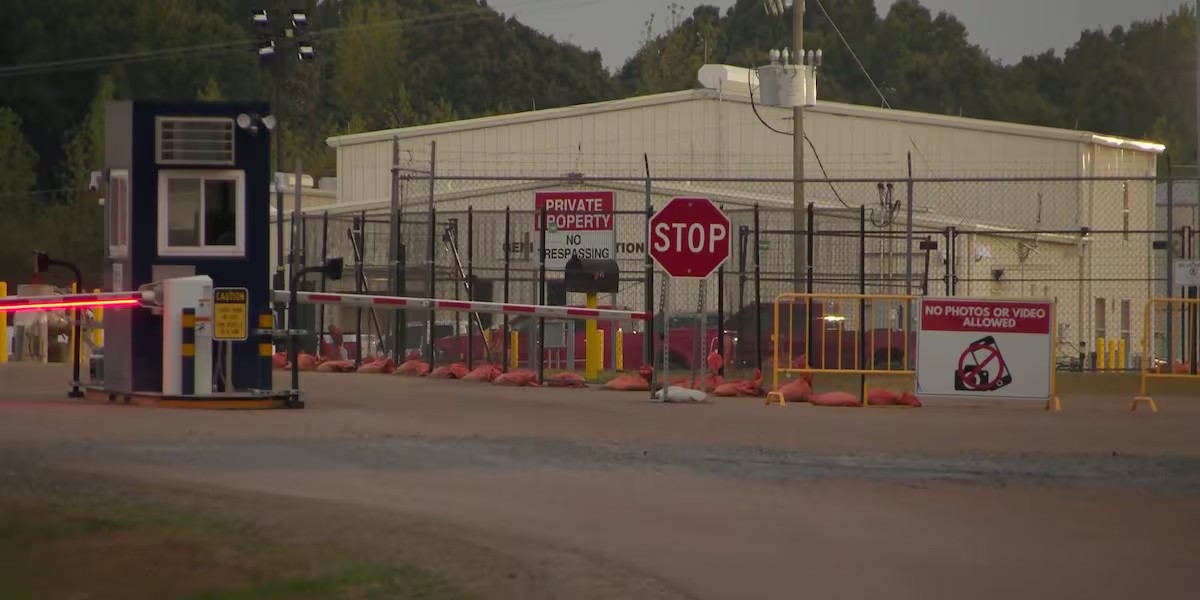
The ditch is the kind of thing nobody looks at twice: a channel along the edge of a development site in Southaven, Mississippi, built to carry storm water off parking lots and away. On Nov. 15 the state’s environmental agency confirmed that between 5,000 and 6,000 gallons of cooling fluid from xAI’s data center campus had leaked, and that some of it reached a drainage channel nearby.
Cooling fluid is the stuff that carries heat out of a building full of servers, the way a radiator carries heat out of an engine. This was propylene glycol, sold under the name DOWFROST HD, a heat-transfer liquid designed to keep pipes from freezing and to stay non-conductive around electrical equipment. It is not gasoline and it is not sewage, and that difference matters for how alarmed anyone should be.
It matters just as much that the public learned the volume from a state agency rather than from the company. The Mississippi Department of Environmental Quality confirmed the spill. xAI has not publicly explained it. In a county that has been adding data center capacity about as fast as anywhere in the country, that silence is the part of the story people will remember.
Why should a reader outside Mississippi care? Because the same pattern is repeating in dozens of counties. A very large electricity and water user arrives with tax incentives, a construction schedule and almost no local enforcement staff, and the first public accounting of what it does to the ground often comes from a state agency confirming a spill after the fact.
The mechanism behind this one is mundane, which is the point. Local reporting says the leak came from a mistake in handling a hose. A campus that size moves coolant through temporary and permanent piping during commissioning, and a hose that is disconnected or misrouted under pressure will empty a tank quickly. Five thousand gallons is roughly the load of a small tanker truck, and nothing dramatic has to happen to release it.
Where the fluid went is what the cleanup is answering. Some of it reached a drainage channel, according to the state’s confirmation, and the cleanup was still not finished as of the report. Drains in a development like this one lead somewhere: a creek, a ditch, a retention pond, eventually a river. Propylene glycol breaks down in soil and water, but it consumes oxygen as it does, which is why a large volume in a narrow channel is a problem for fish even when the chemical itself is mild.
That is the technical version. The political version is that this county has heard the general argument before, in a different key. Community groups in the area have been raising questions about how fast large data centers are going up, and a spill hands those questions a photograph and a gallon count. The dispute stops being about whether the industry is welcome and becomes a question of who is watching it.
The companies have a reasonable case, and it should be made rather than assumed. A data center is the cleanest kind of heavy industry by most of the measures neighbors care about: no smokestack, no fleet of trucks, no discharge in normal operation. The coolant in question is chosen partly because it is less hazardous than the alternatives, and a spill of it is closer to a burst pipe than to a chemical disaster.
That case gets weaker every time the company stays quiet. A short statement saying what leaked, how much, where it went and what is being done about it would answer most of what a neighbor wants to know. Saying nothing leaves the vacuum to whichever account is loudest, and the loudest account is rarely the most careful one.
There is a regulatory gap underneath the silence. Most of what a data center does to its site is governed at the county and state level, through permits for water, wastewater and storm water, and those permits were written for buildings rather than for campuses that draw as much power as a small city. Enforcement depends on inspection capacity, and inspection capacity in rural counties is thin.
The industry’s answer to that is voluntary standards and corporate reporting, which is exactly what a spill tests. A company that publishes an annual sustainability report and does not publish a spill report has told you which numbers it considers presentable.
What happens next is mostly administrative. The cleanup continues, the state has confirmed the volume, and the county will decide whether anything about the site’s permits needs to change. xAI could still say something. Local reporting has described the hose error, and nobody has disputed it in public.
The ditch, meanwhile, is still a ditch. It carried storm water for years without anyone driving out to look at it, and for a few days this month it carried something else, in an amount that had to be measured by a state agency because the company that owns the campus has not said a word about it.