Order a ride on the Las Vegas Strip this week and the car that arrives may not have a steering wheel, a brake pedal, or a place for a driver to sit.
Amazon.com Inc.’s Zoox opened its vehicles to Uber’s app on Monday, the first time the robotaxi developer has let a third-party platform dispatch its fleet. Riders who request UberX, Comfort or Electric can be matched with a Zoox vehicle at no additional charge, and can raise the odds of that match in the app’s settings.
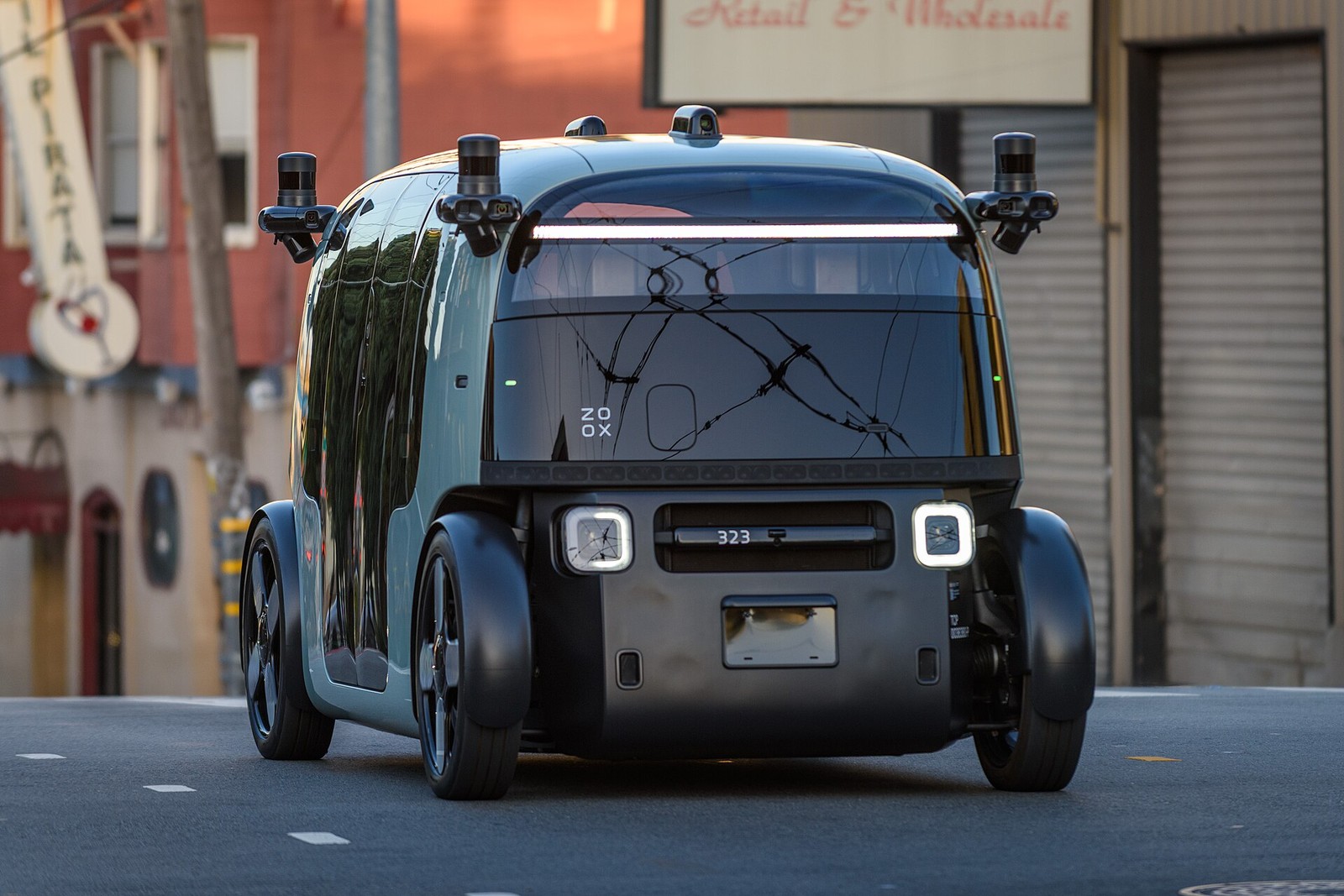
The vehicle is not a converted sedan. Zoox built it for ride-hail from the ground up: a carriage-shaped cabin with seats facing each other, bidirectional steering so it can drive either way without reversing, and no controls for a human. It is the first purpose-built robotaxi to appear on Uber’s network, which until now has been populated by modified production cars.
Uber and Zoox also announced a multiyear agreement with MGM Resorts International, making them the official ride-hail and robotaxi partner across the casino operator’s Las Vegas properties. That piece is easy to read past and probably matters more than the app integration. Robotaxis do not fail because the software cannot drive. They fail because there is nowhere to stop, nowhere to charge, and no permission to occupy the curb at a hotel entrance at 11 p.m. on a Saturday.
Both companies said they plan to launch in Los Angeles in 2027, with Zoox opening rides to its own employees there before the end of this year.
The arrangement inverts the model Zoox has run until now, in which riders reached its vehicles through Zoox’s own app. Handing dispatch to Uber gives the company access to demand it would otherwise have to build one rider at a time, in a city where it is competing against a service people already have on their phones.
For Uber the deal extends a strategy it has pursued for two years: own the customer, not the car. The company’s robotaxi partnerships run through Waymo in Austin and Atlanta, and through arrangements with other developers in several markets. Its bet is that the durable asset in autonomous transport is the dispatch layer and the rider relationship, and that the vehicles will be supplied by whoever wins the technology race.
That bet has an obvious weakness, which is that the winning developer may eventually decide it does not need Uber. Waymo has built its own app and has been slow to expand partnerships. Zoox, owned by a company with its own logistics ambitions, could reach the same conclusion.
For now the incentives point the other way. Zoox needs volume; Uber has hundreds of millions of monthly riders. Uber needs supply of vehicles that can operate without a driver, because its own economics improve sharply when the largest cost line, the human behind the wheel, disappears.
Las Vegas is a sensible place to test the arrangement. The city’s traffic is dense but predictable, its weather is dry, its streets are gridded, and its economy is organized around moving visitors short distances. Nevada’s regulators have been more receptive to autonomous testing than most states. The Strip is also a controlled environment in the way that matters for a first launch: a handful of large properties, each with a driveway and a security staff.
The MGM agreement suggests both companies understand where the bottleneck sits. Access to a resort’s porte-cochere is granted by contract, not by software. A robotaxi that must drop passengers across the street from the Bellagio has a worse product than one that pulls up to the door.
Charging and maintenance are the other unglamorous constraints. A fleet needs a depot within a few miles of its service area, with enough power to charge dozens of vehicles overnight and enough floor space to clean interiors between riders.
The cost comparison is the part riders will judge. Zoox rides on Uber are priced the same as a human-driven UberX, which means the service is not yet competing on price. A robotaxi’s advantage arrives when the vehicle cost is amortized across enough trips per day that the fare can fall below what a driver would accept. Until then, the ride is a demonstration with a meter.
Regulation remains unsettled. Federal rules on vehicles without steering wheels have moved slowly, and Zoox’s self-certification approach has drawn scrutiny. Nevada allows the operation; other states will decide on their own schedules, and a national service would require a patchwork of approvals.
Then there is Tesla, which has promised a purpose-built robotaxi of its own and is converting factory space for it. Tesla’s approach relies on cameras and a large fleet of customer-owned cars; Zoox’s relies on a small number of expensive vehicles it owns and maintains. If Tesla’s version works at scale, the cost structure of the industry changes. If it does not, Zoox’s slower path looks prudent.
For a rider in Las Vegas, none of that is visible. A car with no front seat pulls up, the doors open, and a screen asks whether the seatbelt is fastened. The fare is the same as it was before.
What changes is the assumption underneath it. For a decade the question about robotaxis was whether the software could handle a city. The question now is whether a city can handle the queues, the curb space and the electricity. The Strip is a good place to find out, because everything there is designed to move people quickly and charge them for it.
Zoox has said Los Angeles comes next. Whether the second city arrives on schedule depends less on the driving than on how many depots it can lease.