
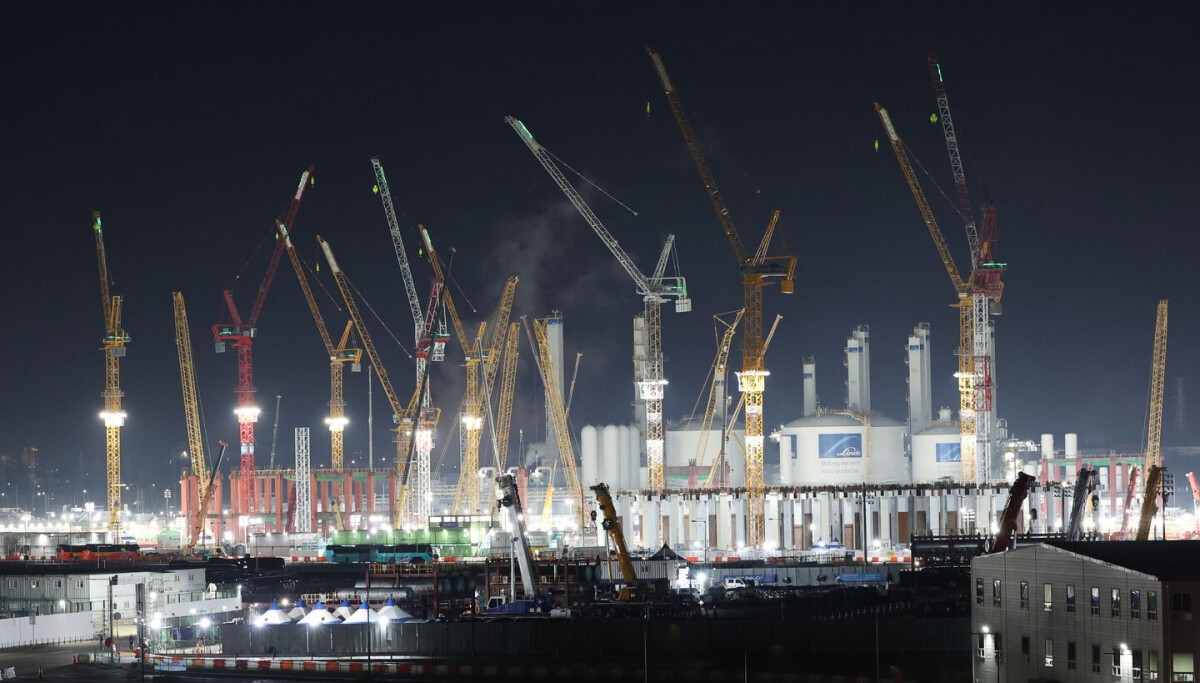
Samsung Electronics is putting almost everything it spends on plants and equipment into semiconductors. A tally published by Digitimes this week put the chip division’s share of the company’s capital expenditure at about 93%, with research and development spending at a record for the period.
The figure is the clearest statement yet of where Samsung thinks its future sits. The company spent 56.9 trillion won on facilities and 41.8 trillion won on research in the first three quarters of the year, according to regulatory filings in Seoul, sums that dwarf what its consumer electronics and display businesses consume.
Memory is the reason. Samsung has been chasing SK Hynix in high-bandwidth memory, the stacked chips that sit next to artificial-intelligence accelerators and determine how fast they can be fed. Hynix got there first with the products Nvidia needed. Samsung has been qualifying its own versions and rebuilding yield, and both efforts are expensive in ways that show up in exactly these two lines.
The foundry business explains the rest. Samsung is the only company other than TSMC attempting leading-edge contract manufacturing at scale, and it has spent years and billions of dollars trying to convince customers that its yields are competitive. Its Taylor, Texas plant has been the most visible part of that campaign, and the schedule has slipped more than once.
Capital spending at that concentration carries a risk that investors have been pointing out for two years. A group that directs 93% of its investment into one division is a group whose earnings will swing with memory prices, and memory prices have historically swung hard. The counterargument is that the AI buildout has changed the cycle, at least for the current generation of products.
Samsung’s component affiliate gave the market a second piece of news on the same day. Samsung Electro-Mechanics said it had expanded its supply agreement with Nvidia, adding multilayer ceramic capacitors to a relationship that previously covered advanced package substrates. The company’s shares rose more than 5%.
The capacitors are a small component with an outsized role. An AI server needs more than ten times as many of them as a conventional server, because the power delivery to a dense accelerator board has to be smoothed at many points and at close range. Samsung Electro-Mechanics holds an estimated 40% of the market for AI-server capacitors, which makes it a bottleneck in a supply chain that has several.
The revised agreement also covers more substrates for Nvidia’s next generation of graphics processors. Nvidia is considering additional funding for production infrastructure at the Korean company’s plants in Sejong and Busan, following an October commitment to help finance dedicated lines at both sites. Samsung Electro-Mechanics said it plans to have a full mass-production system running from 2029.
For Nvidia, spreading substrate supply across several vendors is a hedge that has become more urgent as AI systems grow. The company’s interim chief executive, Colette Kress, said on her earnings call this week that Nvidia had signed new substrate agreements with Kinsus and Samsung Electro-Mechanics, along with an advanced packaging agreement with SPIL.
The competitive picture in memory has shifted twice in three years. Hynix took the lead in high-bandwidth memory when Nvidia needed a supplier that could ship at volume, and held it through several product generations. Samsung’s response has been to spend, on capacity and on the packaging steps that turn memory stacks into modules a customer can mount. Capital expenditure is the only lever that moves those yields at the pace the market expects.
Samsung Electronics also used the week to push back on a claim that has been circulating among investors. The company said demand from new cloud providers is real, and rejected the argument that the AI buildout has outrun its customers’ ability to pay for it. That is the same position Nvidia took in its own results, where revenue and guidance both came in above expectations.
The two companies are now tied more closely than their corporate structures suggest. Nvidia’s accelerators need Samsung’s memory and Samsung’s capacitors, and Samsung’s foundry needs customers willing to commit to capacity years ahead. Money moving from Santa Clara to Sejong is one way of making that relationship durable.
The company’s consumer businesses have been run for cash rather than growth for several years. Phones generate steady profit at thin margins, televisions and appliances less so, and the display unit sells panels to competitors as well as to Samsung’s own handset division. Those units are not where the investment is going, and their managers know it.
What the 93% figure does not show is return. Capital intensity of that order takes years to convert into earnings, and the market has been patient with Samsung partly because its balance sheet allows patience. If memory prices hold through next year, the bet will look prescient. If they do not, the company will have committed most of its investment budget to the one business that has historically been the most volatile.
For now the direction is unambiguous. A conglomerate that once spread its capital across televisions, phones, appliances and displays has become, in investment terms, a memory and foundry company with consumer businesses attached. The filings this week made that official in numbers rather than strategy slides.



