
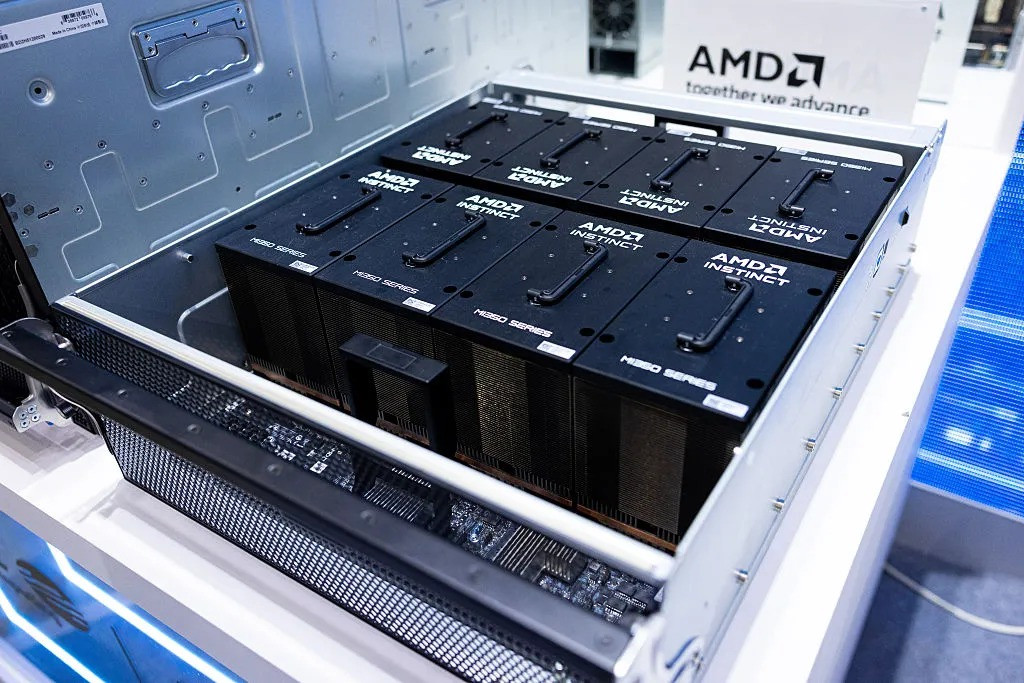
The claim is narrow and the number is specific. In a post published Nov 18, OpenAI said its models took part in part of the design optimization of Advanced Micro Devices’ flagship GPU, identified roughly 14% of additional performance in that design, and compressed a process that had taken close to a year into less than five months.
The account OpenAI gave of the method is a loop rather than a single insight. The model is given the design’s constraints, generates candidate configurations, and engineers then verify each one against the physics and the manufacturing rules before anything is committed to a mask set. Nothing in the description suggests the model replaced the engineers, and OpenAI does not say it did.
That division of labor is where the number has to be examined. A 14% gain in a flagship part is large for a mature design and ordinary for a design that had not been fully optimized. Whether the figure reflects a better search through a space engineers could not cover by hand, or a design that was simply less mature than a shipping part, is not something the post answers.
Neither company said how many chips the method would be applied to. That omission matters more than the percentage, because the value of a design tool is in reuse. A single successful tape-out is an anecdote; a tool that shortens every program by months is a change in how a chip company spends its engineering budget.
The bottleneck it targets is real and expensive. Modern accelerator design is less a matter of inventing circuits than of exploring combinations: cache sizes, interconnect topologies, clock domains, floorplans, all of them interacting through power and thermal limits. Teams use software to search that space already, and the search has always been limited by how many candidate designs can be simulated in the time available.
A model that proposes plausible candidates before simulation is a filter on that search rather than a replacement for it. That makes the productivity gain dependent on the quality of the verifier, and it moves the constraint to verification capacity, which has been the growing cost in chip design for a decade.
For AMD the timing is pointed. The company is trying to close a gap with Nvidia that is measured partly in silicon and largely in software, and it is doing so while its own customers ask for parts that do not exist yet. Anything that shortens the interval between a specification and a working chip is worth more to the second-place vendor than to the leader, because the leader’s advantage compounds with every generation it ships on schedule.
For OpenAI the post is a product argument as much as a research note. The company has been making the case that its models are useful for technical work rather than for conversation, and a chip design collaboration is a harder claim to dismiss than a benchmark score. It is also a reference customer story told by the supplier, which is the kind that tends to omit the failure cases.
The comparison that would settle the question is a controlled one: the same design team, the same target, the same schedule, with and without the model. OpenAI did not present one, and AMD has not published its own account. Both companies benefit from the ambiguity, which is why neither has been in a hurry to resolve it.
There is a broader argument the announcement joins. Chip design has absorbed software automation in stages, from schematic capture to place-and-route to machine learning in the physical design flow, and each stage moved the human contribution up a level of abstraction. The question now is whether a language model can contribute at the level where decisions are still made by judgment about tradeoffs that have no simulation.
The skeptics point out that the hard part of design is not generating options but knowing which constraints are real. Manufacturing rules, packaging limits and customer requirements are partly written down and partly held by engineers who have seen a program fail. A model trained on text learns the written part and infers the rest, and the inference is where errors become expensive.
The economics of an error are asymmetric. A design that misses its performance target ships at a lower price; a design that fails to yield costs a mask set and a quarter of revenue. Any tool in this loop is trusted in proportion to how cheaply its mistakes can be found, which is why verification, not generation, is where the advantage sits.
AMD’s own position is the least clear part of the story. It has confirmed the collaboration exists and has not said what it intends to do next, whether the method is now standard in its design flow, or whether the 14% figure applies to a part that will ship. Those answers decide whether this becomes a line in a case study or a change in the company’s development calendar.
What the announcement does establish is that the largest model developers now want to be seen inside industrial engineering, not just inside software. The pitch is no longer that a model can write code; it is that a model can find something an engineer missed in a problem with a measurable answer. Chip design suits that pitch because the answer is a number and the number can be checked.
The check is what comes next. A second program, a second vendor and a published comparison would turn the claim into evidence. Until one appears, the useful reading is that OpenAI has produced a credible demonstration with a client who has reason to want it true, and that the industry will treat the number as a hypothesis rather than a result.



