
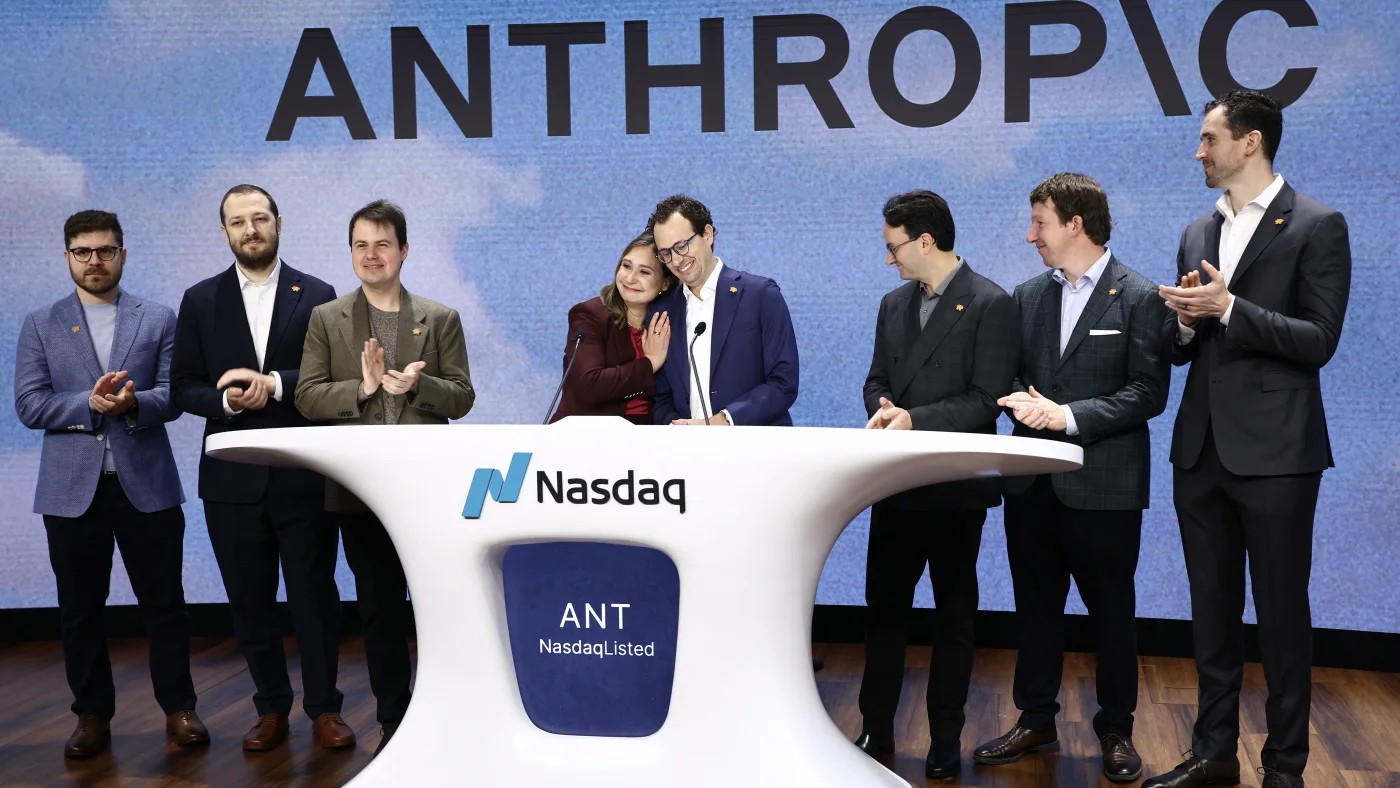
$107.3 billion. That is the total Anthropic raised around its listing, and it makes the artificial intelligence developer the largest new issue in American market history by a wide margin.
The company sold $81.3 billion of stock in its initial public offering and raised another $26 billion in a private placement completed the same day, according to a filing. The shares priced at $83 on Nov. 19, opened at $111.5, reached $115.1 during the session and closed at $97.17, a gain of 17.07% on the offer price.
The gap between the opening print and the close tells its own story. Buyers who received stock at the offer price were up 38.7% at the high and had surrendered more than half of that gain by the bell, which is what happens when supply arrives faster than conviction.
At the offer price the company was valued at about $1.5 trillion on a fully diluted basis, and at the close the figure had climbed to about $1.76 trillion, more than every bank in the country and most industrial companies. The seven co-founders hold stakes worth roughly $166 billion combined, a figure that will be quoted for years.
The first hours of after-hours trading pointed the other way. Prices compiled by Bloomberg showed the shares down about 5%, a modest move that nonetheless matters for anyone who bought near the high.
The proceeds are largely a capacity purchase. Anthropic has spent the past two years signing data center leases and chip supply agreements to keep pace with demand for its models, and the amounts committed run for years. Public equity funds those obligations more cheaply than private rounds, and it does not come with a maturity date.
Demand for the deal was extreme by any measure. About 1,200 institutions placed orders, and more than half received no allocation at all, according to people familiar with the matter. European orders were largely passed over in favor of American accounts, a pattern that will be remembered the next time a large issuer wants European support. Allocation decisions like that are made by the underwriters, and they are rarely explained in public.
The register that did get stock is concentrated. Lightspeed and Iconiq each hold close to 2% of the company, positions worth more than $25 billion apiece at the closing price, and Sound Ventures holds about 0.5%. Factorial Funds put in $565 million and is sitting on a paper return of roughly 19 times.
One industrial buyer stood out. Taiwan Semiconductor Manufacturing Co. disclosed that it bought $500 million of shares at the offer price, about 0.03% of the company, and said it will evaluate an investment in OpenAI next. A supplier taking equity in its customer is unusual, and it reads as a way to hold a seat at the table.
The record it broke belonged to SpaceX, which listed in June. That offering reset expectations for how much capital a private company could raise in public markets, and Anthropic cleared it in a single day with a business that sells software access to models rather than rockets.
The business behind the number is straightforward to describe and hard to value. Anthropic sells subscriptions to its Claude models and access to them through an application programming interface, which enterprise customers use to build their own products. Revenue grows with usage, and so does the cost of serving it.
That cost is the central risk. Training and running frontier models requires computing capacity that is purchased years ahead, and the company’s margins depend on prices for that capacity holding. Investors who bought the stock at $111.5 are underwriting a bet that usage grows faster than the bill for it.
Competition is the second risk. OpenAI remains the largest consumer brand in the category, Google sells models bundled with cloud infrastructure, and both can discount in ways a stand-alone developer cannot match without giving up margin.
The float will also change, and quickly by the standards of a company this size. Early investors and employees are subject to lockup agreements, and the shares that come free over the next year will be large relative to the amount that traded on day one. Index funds will absorb some of that supply, and the rest will meet the market.
For now the offering has done what it was meant to do. It gave the company a public currency for acquisitions, a valuation it can point to when negotiating compute contracts, and a balance sheet that no longer depends on the patience of private investors.
The next test arrives with the first quarterly report as a public company, when management has to disclose revenue, gross margin and the size of its compute commitments in a document that regulators and short sellers can read line by line. Everything in the prospectus was a projection. The filing after that will be a fact.



