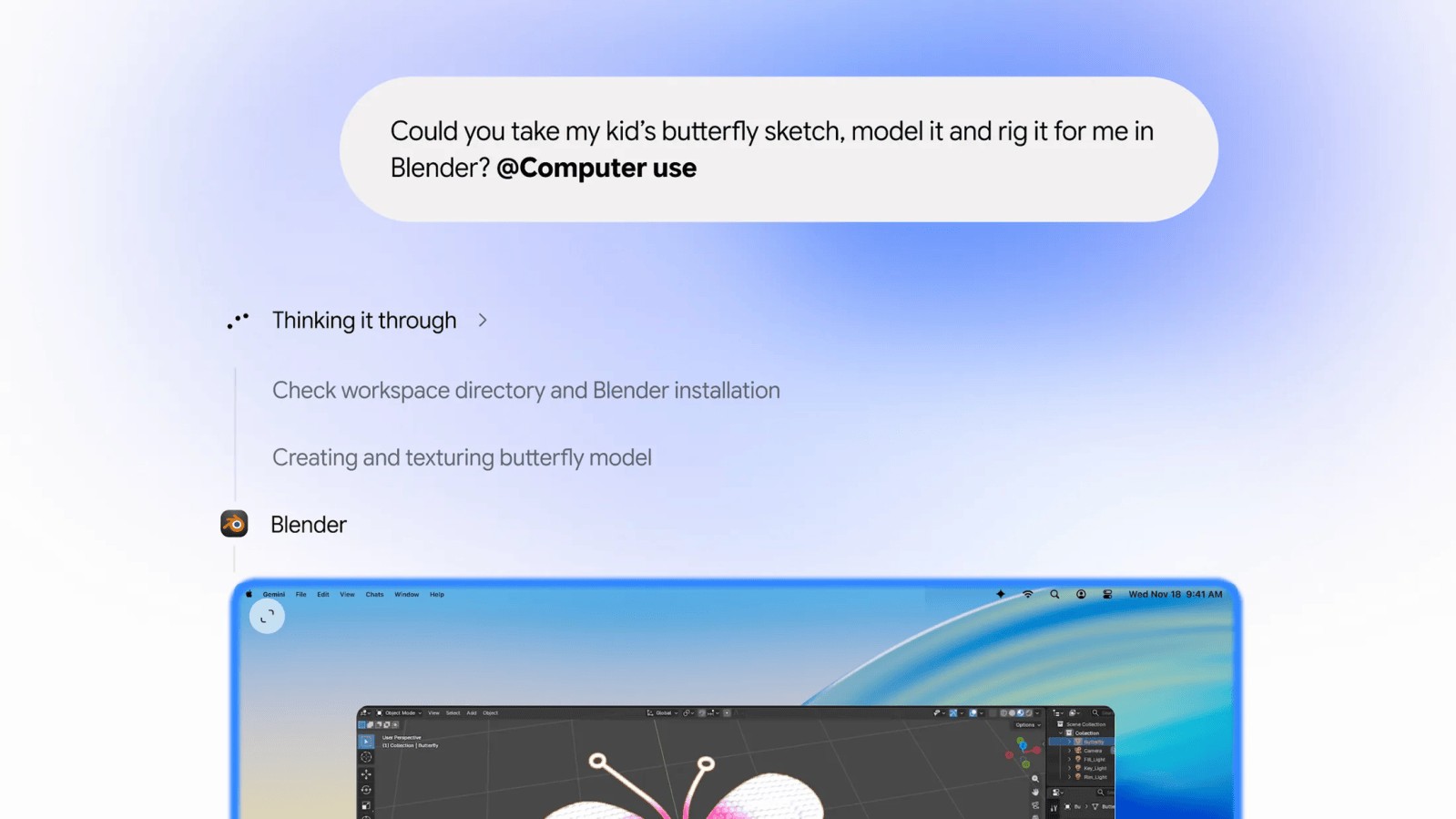
Google pushed an update to its Gemini app for Mac on the evening of Nov. 19, and what it added does not look like a chat box. A user types a request, and the cursor starts moving on its own, opening a document, clicking through a form, closing the tab behind it.
The person who asked is free to work in another window while the assistant handles the one it was handed. Google frames the job as the tedious half of a task, the clicks and the field entries and the copying between apps, with judgment left to whoever gave the order.
That is a different sort of permission than a chat window asks for. An assistant that drives a cursor sits inside the same session as the user’s files, mail and saved passwords, and any text it can read can arrive as an instruction rather than as content.
Google’s documentation for earlier agent features has pointed users toward supervised modes and confirmation steps, and the Mac release keeps the human able to take the mouse back mid-task. Whether that is enough depends on what the assistant is pointed at.
In the same announcement Google moved a research project into the hands of outside developers. Genie 4, an interactive world model, can now be called through the Gemini API, which means a studio or a robotics team can ask for a three-dimensional scene and get one that answers to input instead of a video that plays to the end.
Google has shown versions of the model since 2024 that turn a single image or a line of text into a room a person can walk through. Behind an API the buyers change: game studios testing level layouts, robot teams that need cheap simulated rooms, retailers that want to try a store design before pouring concrete.
The company did not disclose pricing or usage limits in the announcement, which is where the competition will be decided. Nvidia has put its own world models in front of robot makers through Cosmos, and World Labs, the startup co-founded by Fei-Fei Li, began selling generated three-dimensional scenes to studios in late 2025. A model a developer can call with an API key competes on latency and cost per scene, not on a demo reel.
The third item from that day is less visible and probably larger. Reports say Google is going around Broadcom to buy high-bandwidth memory straight from the manufacturers, and Bernstein estimates the shift could save $50 billion over the life of the program.
High-bandwidth memory is the stacked silicon that sits beside an AI accelerator and keeps it fed. Without enough of it, a chip that cost five figures waits. Supply has been the binding constraint on large model buildouts for two years, and Micron said this week that 75% of its 2027 output is already committed.
Broadcom has designed tensor processing units with Google and handled packaging around them. Buying memory directly would move part of that work to SK Hynix, Samsung and Micron, and hand Google a second set of suppliers to weigh against each other.
The $50 billion is a lifetime figure, and it rests on prices nobody has published. For a memory maker, a customer of Google’s size locking in capacity years ahead is worth a discount. For Broadcom, it is a smaller share of a program it has run for a decade.
The agent and the memory order read as one strategy. Google is trying to own the model that acts for a user and the silicon and memory underneath it. Apple, reported to be paying Google for Gemini to rebuild Siri, is a customer at the model layer and a rival at the device layer.
Shipping desktop control on the Mac puts Google’s assistant inside Apple’s operating system before Apple’s rebuilt assistant ships. It also parks Google’s agent beside Microsoft’s Copilot and OpenAI’s operator tools, all of which have converged on the same trick of acting rather than answering.
The commercial logic runs in one direction. Google pays Apple billions a year to remain the default search engine on its devices, a payment now at the centre of the antitrust remedies being argued in Washington. An assistant that works well on a Mac is a way to stay present on hardware Google does not build, whichever way that case ends.
Corporate buyers will ask the questions consumers skip. Which applications the agent may touch, what gets logged, whether an administrator can switch it off across a fleet of laptops. Google has answered much of that for its enterprise tier and little of it for the Mac app, where the only control is a stop button and the user’s own attention.
Regulators have their own list. An agent that reads a screen and clicks is processing whatever sits on that screen, including health and financial records, under rules written for software that waits to be told what to do. The nearer test is more mundane: whether the cursor keeps moving when the connection drops halfway through a form, and whether a wrong click can be undone in the same second it lands.