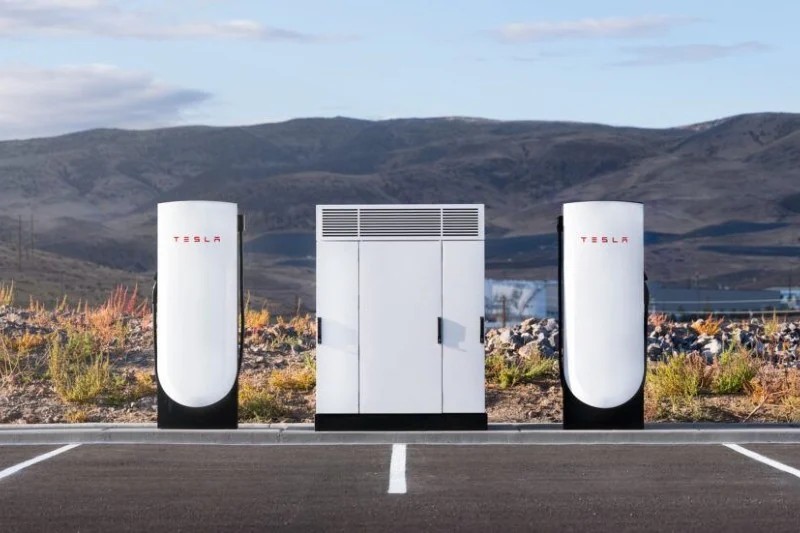
A charging site beside a highway outside a Texas city is an odd place to begin a vehicle program. On Nov. 19 Tesla opened its first Semi charging station in the state, the first site in a network built for trucks rather than for cars.
The truck has been in the works for nine years. Tesla showed the Semi in 2017 and promised production two years later, then delivered the first units to PepsiCo in December 2022 from a low-volume line in Nevada. The charging network is the part that had to wait for a factory.
The hardware is the Megacharger, a charger Tesla has described as adding roughly 400 miles of range in about 30 minutes for the Semi, which the company rates at 500 miles loaded. Those figures decide whether an electric tractor can hold a schedule that a diesel one keeps.
An industry group, CharIN, has been writing a connector standard for this class of charging, with demonstrations above one megawatt and production trucks expected to draw between 700 kilowatts and a megawatt. A site that size needs its own substation, which is why the buildout is slower than the cars’.
Fuel is the reason the math can work at all. Diesel is the largest single operating cost for a long-haul fleet after the driver, and electricity priced at depot rates runs well below it per mile. The obstacle has never been the cost per mile; it is the stop.
A diesel tractor refuels in fifteen minutes at almost any exit. A truck that needs half an hour at a specific site needs that site to exist on the route, with the power capacity behind it, and needs the driver’s mandatory break to fall at the same place. American hours-of-service rules require thirty minutes off after eight hours of driving, which is the slot the charging stop is built to occupy.
PepsiCo took the earliest Semis into service in California, running them out of a Modesto facility on routes that returned to base each night. Depot charging handled that duty cycle. A public corridor is a harder problem, and the Texas site is the first attempt at it.
The second program is stranger. Tesla is planning a version of the Model Y with no steering wheel and no pedals, built to be driven only by software. The Model Y is the company’s best-selling vehicle by a wide margin, and stripping the controls from it is a cheaper route to a driverless fleet than designing a new car.
Tesla has already shown the dedicated version of that idea. The Cybercab, a two-seater unveiled in 2024 and slated for production in 2026, was designed from the start without a wheel or pedals. A modified Model Y arrives from an existing line, with existing tooling, which is why it can appear before the dedicated robotaxi does.
Federal rules are the binding constraint. Safety standards written in the 1960s assume a human at the controls, and a car sold without them needs either an exemption from the National Highway Traffic Safety Administration or a rewritten standard. The exemption route is capped at 2,500 vehicles per manufacturer per year, a number that suits a pilot and not a product line.
State law splits the difference. Texas has taken a light approach to autonomous vehicles and allowed commercial robotaxi service, which is where Tesla began running paid rides in Austin in 2025 with a supervisor in the car. California requires permits for each stage and has been slower to grant them.
Insurance and liability have not been settled anywhere. A vehicle with no controls cannot hand back control, so the question of who is responsible in a crash moves from the person in the seat to the company that wrote the software, and insurers are still pricing that.
The charging network may prove the more durable asset. A megawatt-class site needs utility interconnection, transformers and land, and those approvals take years in most of the country. Tesla already operates the largest fast-charging network in North America, and a truck corridor built on it would be difficult for a competitor to duplicate quickly.
Rivals have mostly aimed at shorter routes. Freightliner’s eCascadia, Volvo’s VNR Electric and BYD’s tractors are sold for regional hauling with ranges near 200 to 250 miles, where a depot charger covers the day. The long-haul segment Tesla targeted remains thinly served, and the failure of Nikola, which filed for bankruptcy in 2025, removed one claimant to it.
Capital is the other constraint. Tesla has been building a high-volume Semi plant in Nevada alongside its battery work, and a driverless Model Y program would compete for the same engineering staff and the same cash.
Tesla has not said when the control-free Model Y reaches a line, which state would license it first, or how many trucks the Texas site can serve in a day. The station is open, and the vehicle it is meant for is still being counted in single units.