
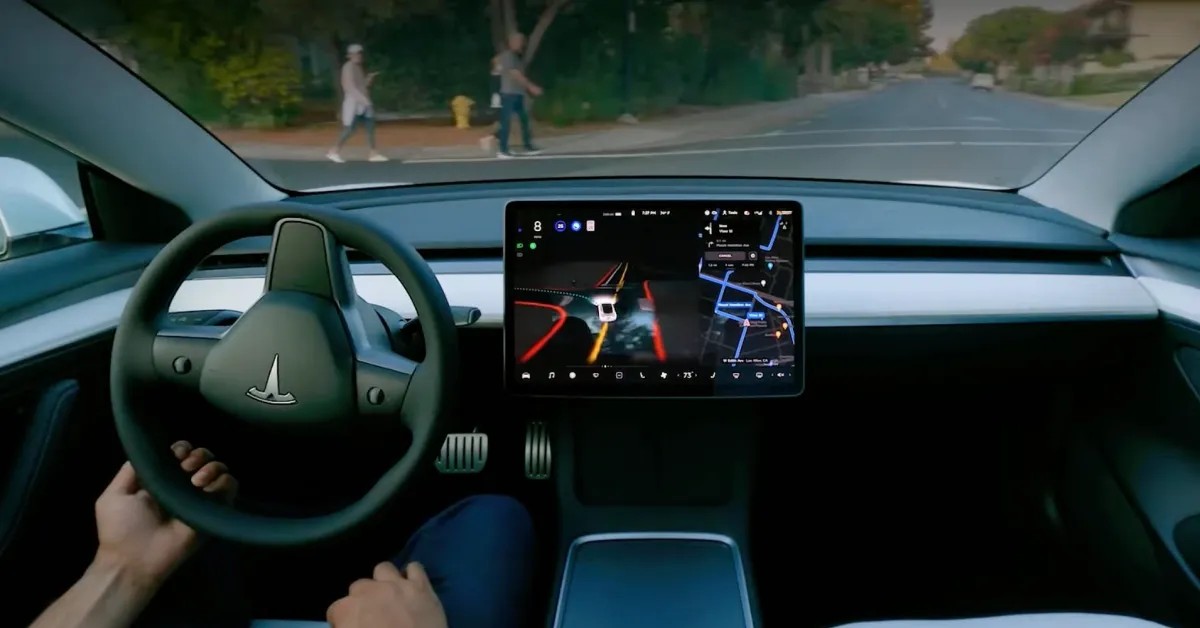
On Nov. 20, Italy’s transport minister, Matteo Salvini, posted that his ministry had finished a technical review and granted Tesla temporary approval for its driver-assist system. The decision made Italy the first major European Union market to admit the software, which Tesla sells on the continent under a renamed version of what it calls Full Self-Driving in the United States.
The approval is narrow. The system is a Level 2 driver-assist product, meaning the car can steer, brake and change lanes on some roads while the person behind the wheel remains responsible and must keep watching. It is not a robotaxi feature and it does not let a driver take their hands off the wheel for long. Tesla will sell it as a subscription at 99 euros a month.
The decision belonged to one minister, and that is how it should be read. The minister, who is also deputy prime minister and leads the League, has made a habit of announcing approvals and investments himself, on social platforms, ahead of the ministries’ own press offices. Transport is a portfolio he has used to signal that Italy is open for business, and a Silicon Valley carmaker’s software is a useful prop for that message.
The motive is partly industrial. Italy’s vehicle production has fallen for years, Stellantis has cut shifts at plants in the south, and the supply chain that fed them is thin. A ministry that clears new automotive software quickly is advertising something to manufacturers beyond one subscription: that Rome will move first and argue later.
That posture separates Italy from the two markets that matter most. Germany and France have not approved the system, and both have regulators that treat driver-assist claims with suspicion, partly because of liability rules and partly because of the history of overpromised automation in European advertising. The eleven countries that cleared it before Italy were smaller markets, where a national approval is easier to grant and less consequential to lose.
The European layer is where this gets decided. Whole-vehicle type approval is a Brussels function, and a single member state cannot open the whole union on its own. The technical committee that would extend approval across the bloc could vote as early as December, and the threshold is steep: at least 15 member states representing 65 percent of the population. Two large states can block it. Germany’s abstention would make the arithmetic hard.
Tesla’s European arm said it will begin the rollout in Italy. The company has reasons to want a win there. Registrations of its cars fell sharply across Europe in 2025 as buyers moved to cheaper Chinese models and to rivals with newer lineups, and the brand’s political associations in some markets did it no favors. Software is the one product Tesla can sell to cars already on the road, at almost no incremental cost.
The economics of 99 euros a month are different from the American model. In the United States, Tesla sells the package outright for a one-time fee and also offers a subscription, and it has spent years arguing that the software improves enough over time to justify the price. In Europe, a monthly plan sets a lower barrier and a shorter decision: a driver can cancel in any month, which makes retention the measure that matters rather than the sale.
Attach rates will be the number to watch, and Tesla does not publish them by country. A rough frame: a fleet of a few tens of thousands of cars, a take rate in the low single digits, and a subscription that costs less than a set of winter tires. That is real revenue and better margin than a car sale, and it is not yet a business that changes a quarterly report.
The cost side is liability. A Level 2 system leaves the driver responsible, and European regulators have been strict about how such systems are marketed after a series of crashes involving other brands. A single well-publicized incident with the system engaged would give every skeptical regulator on the committee a reason to wait, and it would land on a minister who approved the software personally.
There is also the question of what the temporary approval means if Brussels says no. National derogations can be narrow and time-limited, and a rejection at the committee would leave Italy with a product its neighbors do not allow, sold to drivers who cross borders. That is an awkward place for a carmaker and a worse one for a ministry that has already taken the credit.
For Tesla, the Italian decision buys time and a reference case. A twelfth national approval, in a market of 59 million people, gives its lawyers something to point at when the committee meets, and gives its sales staff a reason to call fleet customers. For Rome, it is a small piece of industrial policy conducted by press release.
The committee’s vote is the next date on the calendar, and December is close. Until then, the software is available in Italy on a temporary basis, granted by a ministry that has not published the full technical file, and the rest of Europe is watching a decision it did not make.



