
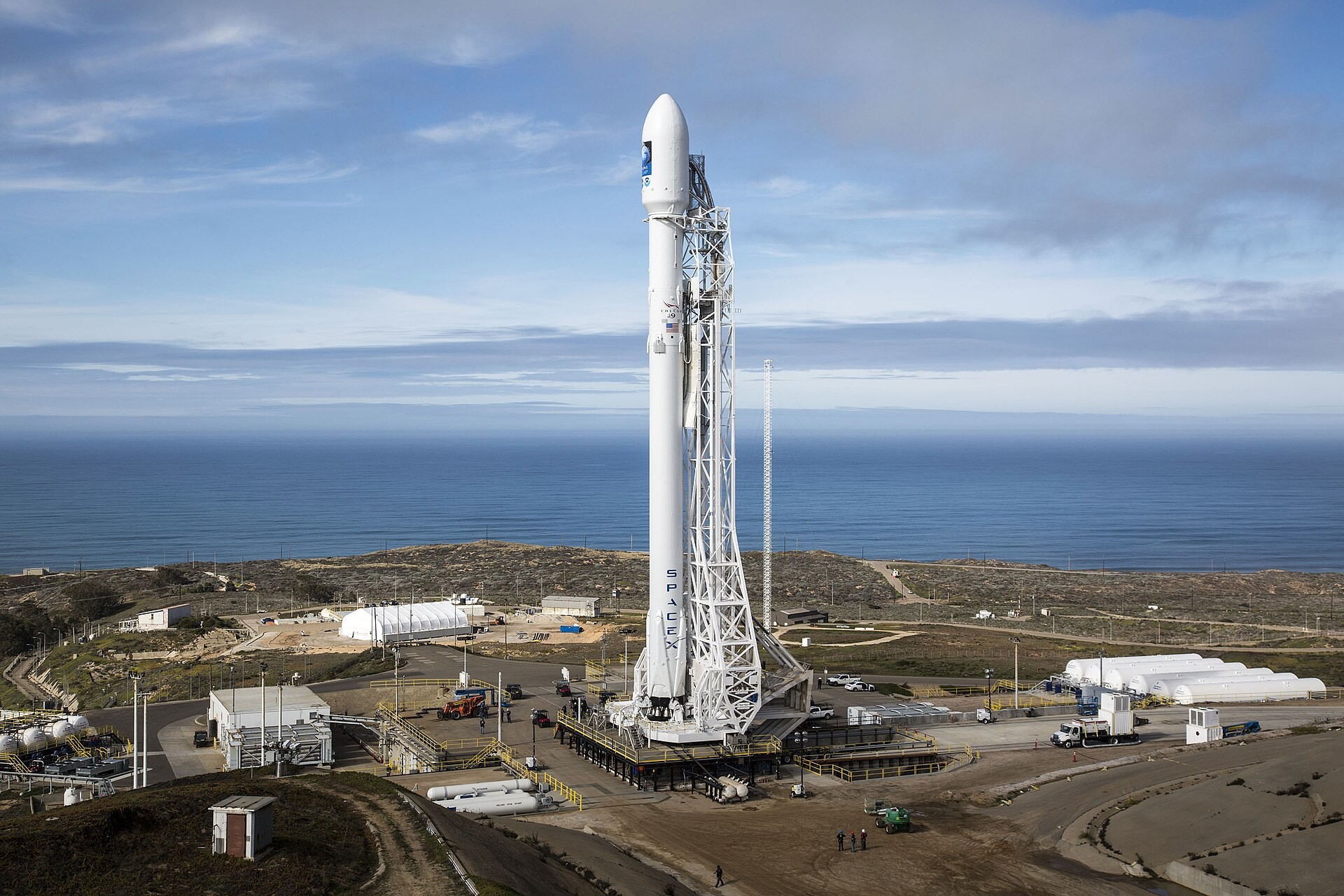
SpaceX launched a National Reconnaissance Office payload from California on Nov. 22, and the informative part of the announcement was what it left out: no orbit, no mass, no description of what the satellite does, and no date on which it would begin work. That is normal for the agency, and that is the point. A launch that would once have been a line in a defense trade journal is now a routine purchase from a commercial supplier, and the public account of it has shrunk to a mission number.
The rocket was a Falcon 9 flying from Vandenberg Space Force Base, which sends missions south over open water when the target orbit is polar. The NRO said the payload was designated NROL-136 and that the flight had been postponed several times. It did not say why, and SpaceX did not either.
Range scheduling explains part of the slip. The California range handles civil, commercial and military flights from a fixed number of pads, and a delay in one program pushes everything behind it. Neither party attributed these postponements to a specific cause.
The mechanics behind that silence are ordinary. The NRO builds and operates the satellites that produce much of the imagery and signals intelligence the US government uses, and its budget sits inside the classified national intelligence total. Mission designations are sequential labels, not descriptions. Orbit parameters are withheld because a rival that knows the altitude and inclination of a reconnaissance satellite can work out what it can see and when.
What has changed is the industrial arrangement. For decades, the agency’s largest satellites flew on rockets built for government customers, on contracts that priced in low volume and long lead times. Under the National Security Space Launch program, the Space Force now buys launches in blocks from a small set of providers, and SpaceX holds a substantial share of that work alongside United Launch Alliance and, more recently, Blue Origin.
Fixed-price blocks pushed price per launch down and cadence up. The agency also changed what it buys: instead of a handful of very large satellites, it has moved toward a proliferated architecture of many smaller ones, which spreads risk across a constellation and makes each individual loss less damaging.
That shift explains a launch like this one. More satellites mean more flights, and more flights mean the calendar fills with missions whose contents are never described. The commercial rocket becomes a utility, and the secrecy moves entirely into the payload. The agency has described that shift in public remarks, and its manifest has followed: missions from Florida and California now arrive within weeks of one another rather than quarters, and the individual satellite has become less interesting than the size of the fleet.
There are costs to that arrangement too. A single provider carrying a large share of national security launches creates concentration risk, which is why the Space Force structured its contracts across several companies and why the failure of any one rocket fleet becomes a scheduling problem for programs it does not own.
The regulatory layer is thin by design. Launch licenses cover range safety, debris and reentry, not the purpose of what goes up. Congressional committees with oversight of intelligence programs are briefed in closed session, and the public record of those briefings is a line item and a hearing title.
Competitors are watching the cadence more than the payloads. China has been building its own imagery constellations and launching them at a pace that US officials have described as a concern, and Russia has kept a smaller but active military space program. Counting launches is one of the few open measures of how fast each side is adding capacity, and commercial flight records make that count easy to keep.
That is why the NRO’s launch schedule gets read as strategy even when nothing about the satellites is public. A busy year of flights from California and Florida implies a constellation being refreshed or expanded, and outside analysts infer the shape of the program from the tempo rather than from the hardware.
The comparison with commercial space is instructive. When SpaceX flies Starlink batches, the company publishes orbit, mass and the number of satellites, because the service is regulated, marketed and sold. When it flies for the NRO, the same rocket, the same pad crews and much of the same hardware produce no public data at all.
Price per launch is the figure the Space Force publishes, and it has fallen. That number describes the ride and says nothing about the payload, which on a mission of this kind is where nearly all of the money and all of the capability sit.
The boundary between those two modes is now a contractual one. The same launch vehicle can carry a commercial broadband satellite whose parameters are public and a reconnaissance payload whose parameters are not, and the only visible difference is the mission patch.
The open question is not whether the rocket works. Flight records answer that. It is whether a system whose launches are announced and whose contents are not can be overseen by anyone outside a closed room, and whether a price per launch is a meaningful measure when the satellite on top costs far more than the ride.
For now the record consists of a date, a designation and a base on the California coast. Everything that would tell you what changed in orbit is held by an agency that has decided, again, that the answer is not for publication.



