
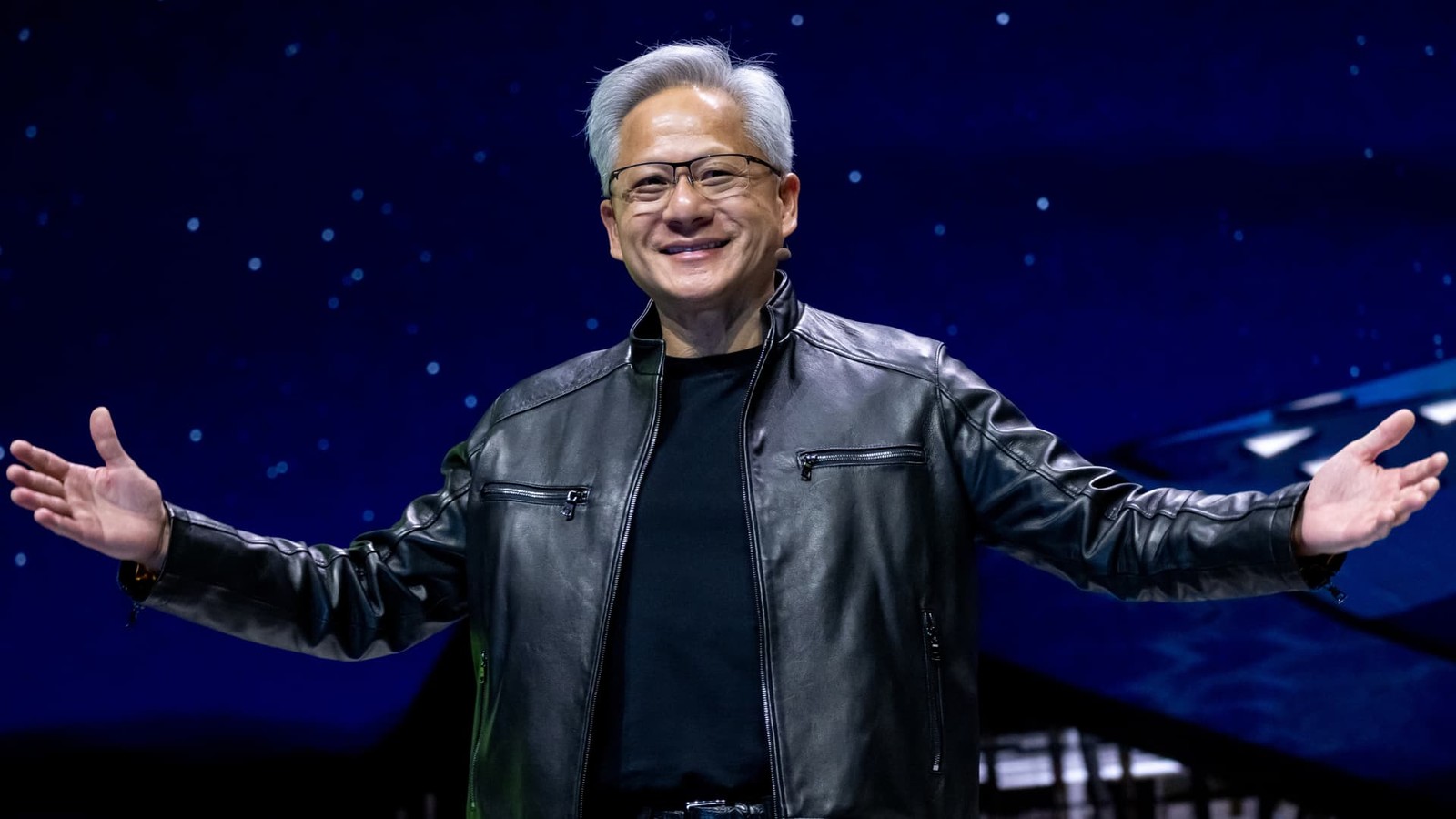
The announcement crossed the wire before the market opened in New York, and by the close the number attached to it had grown larger than the gross domestic product of most countries. Nvidia said it had restored Jensen Huang as president and chief executive, effective immediately. The stock rose as much as 35%, its largest intraday gain since 2000, and the company’s market value increased by more than $1 trillion within a few hours of trading.
A 35% move in a company of Nvidia’s size is not a normal session. It is the kind of repricing that happens when a large group of investors simultaneously discover that the risk they were pricing no longer exists, and then discover that they are not the only ones who noticed.
The mechanics of a day like that are worth separating from the story. Index funds hold Nvidia because it is in the S&P 500 and the Nasdaq 100, so a 35% gain in one stock lifts both benchmarks mechanically, and it did: both closed higher. The Philadelphia Stock Exchange Semiconductor Index jumped 13%, a sign that the move ran through the sector rather than staying inside one ticker. Energy suppliers and industrial companies tied to AI infrastructure deals also rose, which is the part of the tape that says investors were not buying Nvidia so much as re-buying the trade it anchors.
Short covering almost certainly amplified the move. A stock that has been falling on governance uncertainty attracts short sellers, and a surprise reversal forces them to buy back at whatever price is available. Nobody has published figures on how much of the 35% was shorts closing and how much was new money, and the distinction decides whether the gain holds.
The board’s statement, issued the same day, described a unanimous vote. It said the directors had held several rounds of discussion and meetings with Huang, had weighed his candor and his ability to lead the company, and had concluded that his return served shareholders, employees, partners and customers. The statement also said the board consulted senior officials in the U.S. government and concluded that his reinstatement raised no national security concern.
Colette Kress, who had been running the company as interim chief executive, returns to her role as chief financial officer. Harvey Jones remains chairman. The independent committee that had been investigating the matter will continue its work, the company said, and Nvidia will create a chief compliance officer position while cooperating with government inquiries. Those details matter for anyone trying to decide whether the governance problem has been resolved or merely paused.
Elon Musk, whose companies buy a great deal of Nvidia hardware, reposted the statement with a short comment saying the error had been corrected. He had earlier posted that the matter was handled, and had said before that hiring Huang would be an honor. His endorsement is not a legal finding, but it is the sort of signal that moves retail sentiment faster than a filing does.
The scale of the reaction points to how much of Nvidia’s valuation had been resting on a single person. Investors were not repricing the company’s chips, its backlog or its customers. They were repricing the probability that the person who built the company’s position in accelerated computing would be the one directing it. When a discount that large is removed in one session, the resulting move says more about the discount than about the business.
That is also the uncomfortable part. A company whose value can swing by a trillion dollars on a personnel decision has a concentration problem that no compliance office fixes. The market has spent three years treating Nvidia as the purest available exposure to AI capex, and the events of the past weeks showed what happens when the instrument carrying that exposure develops a governance question.
Analysts who cover the stock now face a modeling problem. The company’s fundamentals did not change on the day of the announcement. The demand for its accelerators, the constraints on advanced packaging and the lead times customers report were the same at the open as at the close. What changed was the assumption about who would be making allocation decisions for the next several years, and that assumption is not something a spreadsheet handles well.
The broader market read the move as a risk-on signal. Money that had been parked in defensives during the uncertainty flowed back into semiconductors, and the breadth of the rally, from chip equipment to power generation, suggests investors were re-establishing positions they had cut rather than chasing a single name.
Two questions are still open. The first is what the continuing investigation finds. The committee is still working, a compliance function is being built, and the government inquiries have not concluded, which means the resolution announced on Nov. 23 is a personnel outcome and not a legal one.
The second is what happens to the trillion dollars if the investigation produces something the market has not priced. Gains of this size are lent, not given. They hold as long as the story that produced them holds, and the story now depends on an inquiry that no one outside the board has seen the contents of.
Huang has not spoken publicly about the terms of his return, and the company has not disclosed them. What is known is that he is back, that the stock repriced in hours, and that the people who sold during the uncertainty have not been offered a second chance at those prices.



