
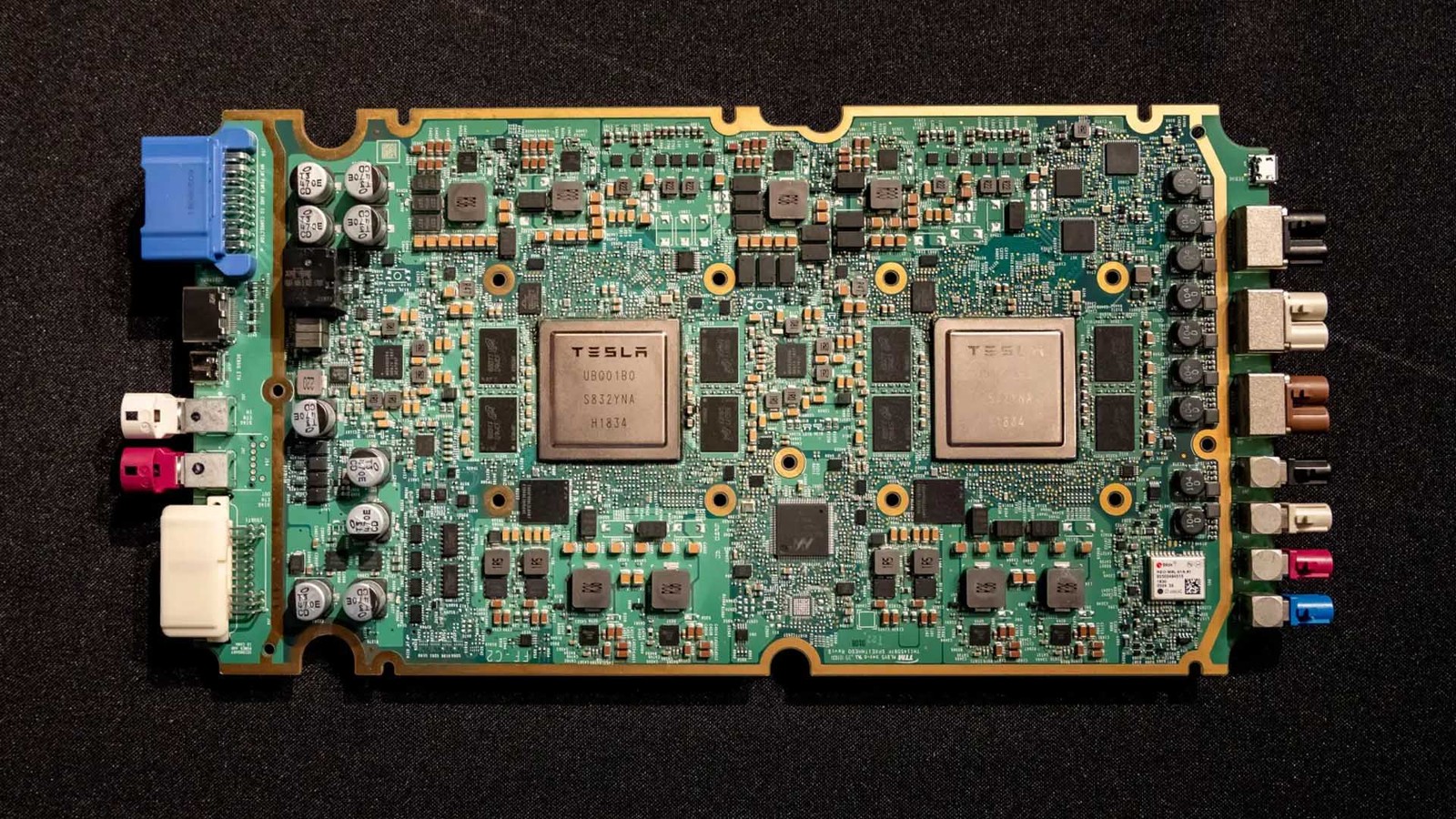
On November 22, Elon Musk wrote that the bill of materials for Tesla’s AI4 onboard computer had doubled, and he put the cause on parts Tesla does not make: DRAM memory and NAND flash. The post was short. It named no supplier, no price and no model year. It did, however, attach a concrete claim to a component most buyers never think about, and it landed in a week when memory had become the scarcest input in the computing supply chain.
AI4 is the computer Tesla designs and installs in its own vehicles to run the driver assistance software the company sells. Every car that ships carries one, so the cost of that board is multiplied by production volume rather than by the number of customers who pay for an optional feature. A doubling on that line does not double the price of a car. It does move a number that management had treated as fixed, and it moves it in the direction that hurts a manufacturer already selling vehicles on thin margins.
What Musk described is visible elsewhere in the supply chain. People familiar with the matter said on November 24 that Samsung Electronics has effectively sold out its memory output for 2027 through 2029, and that some customers are now asking to extend long-term contracts out to 2031. The same people said the largest memory makers can currently cover only about 60 to 70 percent of what customers want. When demand outruns supply by that margin, price stops being a negotiation and becomes an allocation mechanism. Buyers with the least bargaining power, or the least appetite for multiyear commitments, pay the most.
Tesla has not broken out the cost of AI4 in a filing, and Musk did not give a dollar figure. That gap matters for anyone trying to size the effect. A board-level computer is a modest slice of a vehicle’s bill of materials, so even a doubled component cost can be absorbed without a sticker change. The arithmetic changes with scale. A fixed increase per unit, multiplied across a year of production, turns into a line that shows up in gross margin, which is where investors will look first.
The timing is awkward in a specific way. Automakers buy memory on contracts that run for quarters, and the agreements now in force were struck before this year’s tightening. Part of Tesla’s exposure therefore arrives late, when those older contracts roll over and are repriced at the new level. Musk’s post reads as a warning about that rollover as much as a statement about today’s costs.
There is a second question, which is who pays. Tesla sells into a market where price has been the deciding variable, and a cost increase on a mandatory component forces a choice between margin and market share. Musk framed the change as a fact rather than a plan, offering no indication of whether vehicle prices will move. Any hardware company with a published price and a fixed bill of materials sits at the same fork, and the ones with the least differentiation have the least room to pass costs along.
For the memory makers the picture is the mirror image. Scarcity that runs into 2029 gives them pricing power they have not held in years, and it gives their customers a reason to sign longer commitments than they once considered prudent. The buyers asking for terms through 2031 are trading flexibility for certainty about supply. That is what a shortage does to a market over time: it lengthens contracts and shortens patience.
The distinction between the two memory types in Musk’s post is worth keeping straight. DRAM holds the working data a processor needs while it runs; NAND stores data when the power is off. Both sit on the same board inside AI4, and both have been repriced by the same shortage. A doubling in the combined memory content is what makes the total bill double, even if the rest of the board did not change at all.
For Tesla, the longer-term exposure sits in its installed base. Cars already on the road carry AI4 and cannot be upgraded without a service visit, so the memory inside them was bought at older prices and is already paid for. The cost pressure lands on new production, which is exactly the volume Tesla needs to keep growing. A company that built its brand on software updates delivered over the air now finds that the hardware enabling those updates is the constrained item.
The wider read is about where AI demand now shows up. Data center accelerators take the headlines, and the same week brought a rally that added more than a trillion dollars to Nvidia’s market value in hours. The memory that feeds those accelerators also goes into the computers inside cars, and both draw on the same limited fab capacity. When Musk says a car computer’s cost doubled, he is describing a supply chain in which the automotive buyer is the smaller customer at the table.
Tesla has not said whether it will redesign AI4 around less memory, renegotiate its supply agreements, or pass the increase to buyers. Musk set out the problem and left the response open. The next set of quarterly numbers, or the next adjustment to the configurator, will be the first place the answer becomes visible, and neither has a date attached.



