
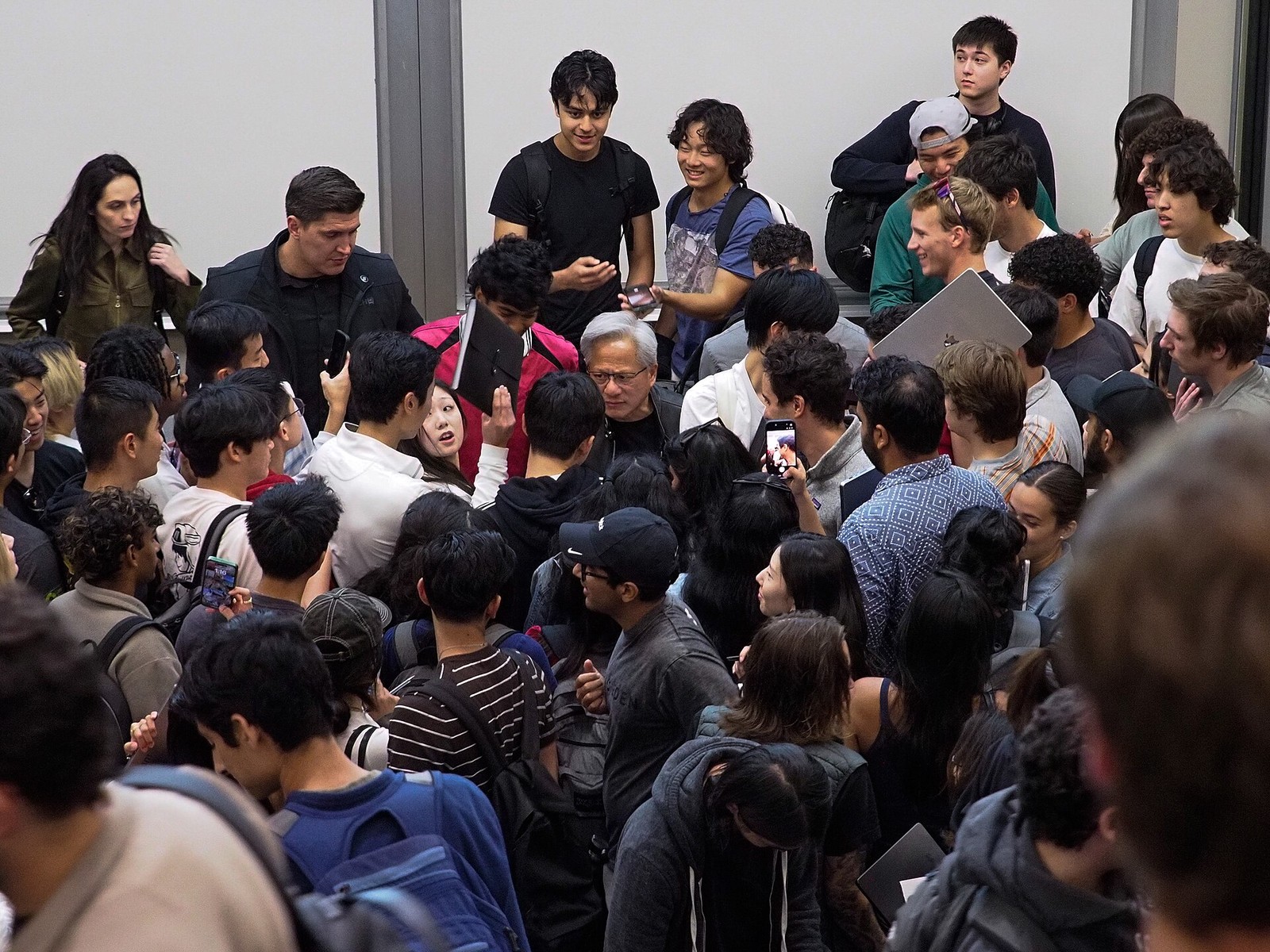
Jensen Huang used his first all-hands meeting since returning as Nvidia’s chief executive to apologize to employees and acknowledge that he had violated the company’s code of conduct. In the same session, held on the evening of Nov. 24 Eastern time, he ruled out a succession plan for himself.
He told the room that he receives 90 minutes of treatment every day. The admission of a conduct-code breach and the disclosure of ongoing care arrived in the same speech, at a meeting meant to reset his second tenure. Employees had come for an account of how the past months happened. They got an accounting of the present instead.
Huang also rejected reports that the Trump administration pressed the board to bring him back. Those accounts, he said, are “not true,” and Nvidia is “the least political company.”
On the question that has followed him since his return, he was just as direct. The company already has a capable leadership team running each part of the business, he said, and does not need to draw up a succession plan the way an ordinary institution would.
He added that his second stint as chief executive “will do better.” He did not say what he would be measured on, or who would be doing the measuring.
The skepticism has not quietened. NPR and other outlets have argued that the board’s independence was damaged by the sequence of events that produced his return, and analysts have described his position with a phrase that appears in no governance manual: too big to fire. That framing is an admission of a bind. A board that cannot replace a chief executive without hurting the share price has less room to discipline him than its charter claims.
The substance behind the phrase is duller than the phrase itself. Most companies of Nvidia’s scale publish a succession framework, rehearse it with the board and explain the logic to investors. The exercise is dull, and its dullness is the point: it tells shareholders the company does not depend on one person staying alive and well.
Huang’s answer replaces a document with an assertion. He says the leadership team is capable, and by most accounts of the business it is, with operating chiefs over each segment. What an assertion cannot do is bind a future board, or a future proxy fight.
The comparison with his peers is uncomfortable for the company. Founders who retain control usually accept the same trade: they keep the authority and publish enough structure that investors can price the risk of their absence. Ruling out a plan does not remove the risk. It removes the disclosure.
The calendar will test the claim quickly. Huang is due to testify before the Senate on Dec. 3. Nvidia launches new products at GTC the same day, so the company will be selling a roadmap and defending its governance inside the same news cycle.
That collision is awkward for a chief executive who describes his company as the least political in America. Testimony under oath creates a record, and a record invites follow-up questions from legislators with their own audiences. A product launch on the same day guarantees the two stories share a headline, and neither will be read as a product story.
The governance question sits underneath both. A board that reverses itself on its own chief executive, at whatever speed and for whatever reason, has told the market something about how it makes decisions under pressure. Markets do not need a scandal to reprice that. They only need a precedent.
There is also the plain fact of the treatment. Ninety minutes a day is a routine that reorganizes a calendar, and a calendar is how a chief executive allocates judgment. Investors have no line item for that, which is why the disclosure carries more weight than its details. A chief executive who says he is being treated and will do better is asking the market to trust a process it cannot see.
Employees, for their part, were given an apology and a reassurance in one sitting. That combination works when the audience believes the second half, and it works badly when the first half is the only part that was documented in writing.
The company’s answer to the continuity question is, in effect, that Nvidia does not depend on its founder. That may turn out to be correct. It is also the one claim a founder cannot verify on his own behalf, and the only witness who could is a board that has already shown how it behaves when the question gets urgent.
So the cost of the decision will arrive slowly. It will show up in a proxy statement, in the questions senators choose to ask on Dec. 3, and in whatever the company has to say the first time Huang misses a quarter of his calendar.



