
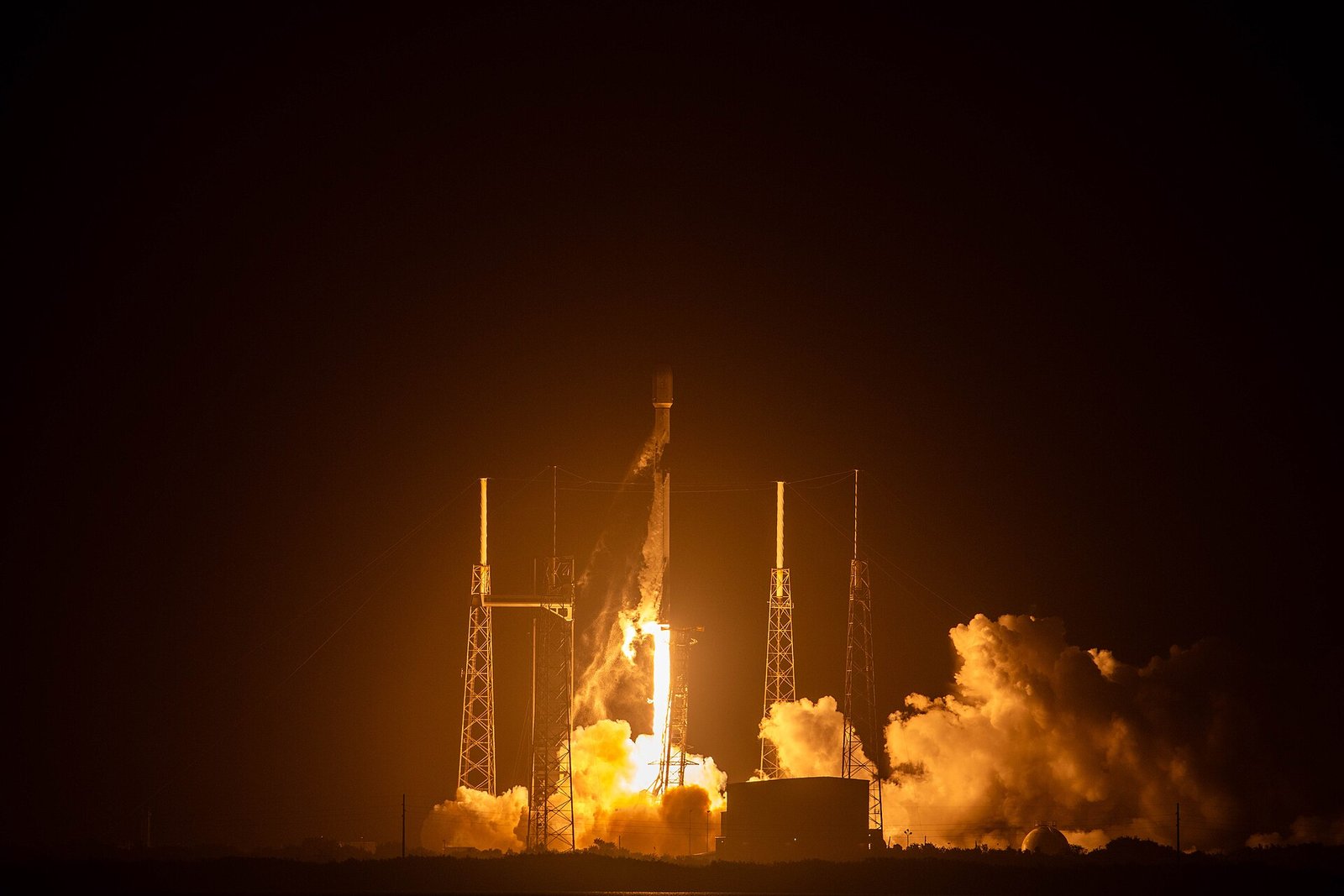
The Federal Communications Commission issued the order the day before Thanksgiving, which is the kind of timing that keeps an approval out of the news cycle. The substance did not stay quiet. The commission granted SpaceX a conditional authorization to deploy as many as one million Starmind satellites configured as an orbital data center. It is the first time a U.S. regulator has approved a project of that kind.
The conditions are a schedule. One satellite must be operating in orbit within seven years. By November 2035, 100,000 must be deployed. The full constellation is to be complete before 2040. The application SpaceX filed in January put the satellites between 500 and 2,000 kilometers above the ground, linked by laser, powered by solar arrays, and cooled by radiating heat into space rather than by the evaporative systems that consume water at ground facilities.
That last detail is the commercial argument, and it is a real one. A terrestrial data center spends a large share of its engineering budget on removing heat, and the constraint is often water rather than electricity. Radiative cooling in vacuum sidesteps the water supply and the local politics of siting a facility that needs millions of gallons. What it does not sidestep is the radiator itself, which has to be large, light and survivable, and which is the component most likely to decide whether the economics work.
Neither the economics nor the engineering was before the commission. The order settles spectrum and orbital resources, and the text says so. The agency did not assess whether the satellites can be built at a workable unit cost, or whether the launch cadence implied by the schedule is achievable. Those are the questions that decide the project, and they will be answered by engineers and by capital markets rather than by regulators.
The commission also declined to conduct a further environmental review of pollution from satellites reentering the atmosphere. Its reasoning was jurisdictional. The National Environmental Policy Act does not reach activities outside the United States, and the agency treated the reentry question as falling on that side of the line. The decision narrows the grounds on which the reentry issue can be raised at the licensing stage, which is where opponents had hoped to raise it.
The American Astronomical Society and other groups had asked the commission to deny the application. Their argument was arithmetic. A constellation of that size would multiply the total number of satellites in orbit by roughly fifty, and the effects they cited were congestion, collision risk and interference with observation. The order does not dispute the arithmetic. It declines to treat the number as a reason to refuse.
The schedule is the part that will be tested first, because it is written in a form that can be verified. A single operating satellite within seven years is a low bar for a company that already runs the largest constellation in orbit. One hundred thousand units by November 2035 is not. The gap between those two requirements is where the program either becomes a business or remains a filing.
For the compute industry, the more interesting question is what an orbital data center is for. A facility in low orbit is poorly placed to serve latency-sensitive workloads, since a round trip to the ground and back is longer than a round trip between two terrestrial sites. It is better placed for work that can wait: training runs, batch inference, and any job whose output is data rather than an interaction. That is a large share of the demand currently constrained by power.
SpaceX is not the only applicant. Blue Origin has filed its own proposal for orbital data centers and is waiting on the commission. A second filing changes the character of the first approval. What looked like one company’s ambition becomes a queue, and a queue is how an agency starts treating a new category as policy rather than as an exception.
The unresolved questions are not small. Who pays for the capacity, and at what price per unit of compute, has not been established. Whether the radiators can reject enough heat at the mass a launch vehicle can carry is an engineering question with no public answer. Whether 100,000 satellites can be operated without a collision that creates debris the industry then has to fly around is a question the commission explicitly did not take up.
The timetable itself carries an assumption that no one at the agency had to defend. A deployment that reaches 100,000 units in nine years, and a full constellation of a million by 2040, requires a launch rate and a manufacturing rate that do not exist in any current program. Licensing a schedule is not the same as funding one. The order gives the company a right to the spectrum it needs if the satellites appear. It does not oblige the satellites to appear.
What the order does establish is the legal footing. A U.S. company can now hold a license for computing in orbit, and the license was granted on spectrum terms rather than on the merits of the business. That is how most infrastructure begins in the United States: the regulator clears the right to transmit, and the market finds out whether the rest of it works. The clock on the first satellite started with the signature.



